


Even if the Ayatollah regime is overthrown in Iran, Israel will still lose. The Israelis believe that if they can topple the Iranian regime, that they can just use whoever will take its place as a tool for their interests. Turkey will be the biggest winner in the case of regime change in Iran. Remember what happened in December of 2024: Assad was overthrown and the Israelis were celebrating that Iran had been toppled in Syria. But all that happened was Turkey became more powerful as it transformed Syria into its protectorate, and now Israel is facing a neo-Ottoman empire right on its border. The Israelis are now so full of trepidation because of the rise of Turkey that it has been begging the Trump administration not to allow Turkey to deploy troops to Gaza, and the US has been working to prevent a clash between Israel and Turkey over Syria. The weakening of Iran actually stoked Turkey to deepen security ties with Iran against Israel, because since Iran got weakened Turkey saw no threat in working with the Iranians. As we read in rfi:
Turkish foreign minister Hakan Fidan, hosted in Tehran by his Iranian counterpart Abbad Aragchi, declared that both countries see “Israel as the biggest threat to stability in the Middle East”, because of its “expansionist policies”.
Ankara is increasingly angry over Israel’s military operations in Syria, which it considers a threat to security. Syria’s new regime is a close Turkish ally.
With the Iranian-backed Syrian regime overthrown and Iran’s diminishing influence in the Caucasus, another region of competition with Turkey, Tehran is viewed by Ankara as less of a threat
“Ankara sees that Tehran’s wings are clipped, and I’m sure that it is also very happy that Tehran’s wings are clipped”, international relations expert Soli Ozel told RFI.
So weakening Iran in Syria only strengthened Turkey, and what do you think will happen if the Iranian regime is overthrown? Turkey will most definitely capitalize on the scene to influence and entrench itself within whatever new government takes the place of the old regime, and Israel will be deeper in the pit that it has been digging for itself ever since it pushed for the overthrow of Saddam (which enabled the rise of Iran against Israel). Israeli official Amichai Chikli affirmed that Turkey currently represents “the greatest threat to the State of Israel.” If the Israelis manage to overthrow the Iranian regime, it will only be helping its “greatest threat”. Israel is like Judas, thinking it will benefit only to destroy itself in the end.
Even if the Islamic regime is gotten rid of, the Iranians will still hate Israel. Hitler is very popular in Iran, and the Iranians see Israel as a threat and untrustworthy, especially after Israel killed over a thousand Iranians in its last war with Iran. So removing the Islamic regime will not help Israel in the end, and Israel will only go deeper in its own pit and will be further tightening the noose around its own neck. No matter who rules over Iran after the Ayatollah regime is gone, Iran will hate Israel. This was observed by a recent article by Michael Rubin:
Many in Israel expect they can renew the warm ties they enjoyed with Iran before the 1979 Islamic Revolution. This, too, is wishful thinking. Many Iranians will resent Israel’s suspected association with the Mujahedin-e Khalq in subsequent years, as well as the tendency of some Israelis to support “South Azerbaijan” separatism. While Crown Prince Reza Pahlavi’s visit to Israel won cheers in Washington, Jerusalem, and among some diaspora Iranians, Israel’s subsequent bombing campaign against Iran offended many Iranian nationalists. Decades of propaganda also take their toll. Egyptians remain overwhelmingly anti-Israel decades after the Camp David Accords; it is unrealistic to believe that generations of Iranians fed anti-Israel conspiracies will switch sides overnight.
Perhaps the biggest long-term winner of the Islamic Republic’s collapse will be Turkey. Just as Qatar replaced Saudi Arabia as a financier for Islamic extremism, Turkey has transformed itself into an ideological engine that seeks to export its own brand of Islamist extremism with an aggressiveness akin to 1980s-era Iran. President Recep Tayyip Erdoğan will see Khamenei’s collapse not as a warning about his own future, but rather as an opportunity to expand Turkey’s own revolutionary export and terror sponsorship.
There is another element that is not being discussed in this Iranian equation, and that is Germany. What is happening in German politics should be a major highlight in international media: both nationalism and militarism are rising. And if history is a teacher, it tells us that when nationalism rises in Germany, the Jews are hated. Right now the second biggest party in Germany is the ultra-nationalistic and militaristic political party Alternative for Deutschland (AfD) which is really a modernly packaged Nazi party. If the Ayatollah regime is no more, that will give the opportunity to both Turkey and its biggest European ally, Germany, to deepen alliances with Iran. Without a doubt, whatever new government takes over Iran, it will be a nationalistic one. A nationalistic Iran, would most definitely deepen ties with a militaristic Germany and Turkey. In this setting, you would have the rise of a nationalist militarist neo-Ottoman Iranian German alliance, all to the applause of the United States which will praise such an alliance. But the Turks, Iranians and German Nazis all hate the Jews. So still, in the end, Israel will lose. What we are facing is the future annihilation of Israel.
Germany, in fact, has a long history of working with the Iranians. There is actually a history of tensions between the USA and Germany over commercial dealings with Iran.
The rift between the US and Germany over Iran is traced back to the 1990s when the Clinton Administration wanted to impose sanctions on Iran on account of its support for terrorist attacks against Americans, especially the suicide bombing of the American Embassy in Lebanon in 1983. According to Seyyed Hossein Mousavian, who served as the Iranian ambassador to Germany from 1990 to 1997, the tension between the US and Germany over Iran was first seen in 1992 at a G7 conference in Munich, when Germany refused to support a US initiated resolution condemning Iran. As Mousavian recounted, Minister Bernd Schmidbauer gave him the details on his conversations with the incoming Clinton administration about Iran: “Mr. Schmidbauer commented that he had never before seen the Americans so serious in their antagonism toward Iran and their hostility to the continuation of warm relations between Germany and Iran.” (Kuntzel, ch. 17, p. 171).
The Clinton administration, in 1995, prohibited all American firms from trading with Iran. But the Germans strove to break the American pressure by intensifying German exports to Iran. “Iranian decision-makers were well aware in the 1990s of Germany’s significant role in breaking the economic chains with which the United States had surrounded Iran”, remembered Mousavian. But Germany’s relation with Iran went beyond economics and into the realm of geopolitics and even, according to Mousavian, ideology. In Mousavian’s words: “the particular engagement of Germany had deeper institutional, ideological, and historical roots.” Peter Rudolf, a member of Germany’s leading think tank, Stiftung Wissenschaft, explained in 1997 that Germany’s ties with Iran was not solely about money: “Economic interests cannot fully account for why Germany has adhered to a policy so much criticized in the United States. And economic interests do not explain why engagement is the widely preferred approach in the German debate about dealing with Iran”.
Rudolf concludes that Germany’s connection with Iran can only be explained in light of a “historically rooted strategic preference.” This historical root was referred to in 1997 by Klaus Kinkel, who at the time was German minister of foreign affairs, when he stated that one must “take into consideration the fact that the German and Iranian people are bound to each other by a century-long tradition of good relations”. (Kuntzel, pp. 174-175) This deeply rooted relationship can be traced back from the 19th century, into the 1920s, into the Nazi era, to now. During the reign of Hitler, many Iranians revered the fuhrer, and today Iran wants to destroy Israel and its biggest backer in Europe is the very country that raised up the Third Reich.
Iran’s president, Rafsanjani, was trying to weaken the effectiveness of US sanctions. But, he also had another goal, one much deeper than what was currently taking place politically. Rafsanjani had a dream of restoring the “strategic alliance” between Iran and Germany reminiscent to the days of the Third Reich when the Nazis were backed by their many Persian supporters. As Rafsanjani would write in 2006, the reunification of East and West Germany brought an opportunity to Iran to revive its alliance with the Germans as it was in Nazi times:
“With the collapse of the strategic alliance between the two countries during the Second World War, the Allies were able to divide Germany into eastern and western parts. …. During the same period, Iran was also technically under the influence of foreign powers. … The reunification of East and West Germany into a sovereign, politically independent Germany in 1990 … provided leaders of both countries with a suitable opportunity to take steps toward the revival of historical ties and the adoption of a new diplomatic approach.” (See Kuntzel, Germany and Iran, ch. 17, p. 169).
This same opinion was echoed by Seyyed Hossein Mousavian, who wrote in his 2008 book, Iran-Europe Relations:
“Iran’s geopolitical situation has long attracted German strategists. This fact was clearly reflected in German military planning during the Second World War … [t]he allied forces occupied Iran, because of its close cooperation with Germany in the war. After half a century of division and weakness, Germany has regained its unity.”
Mousavian then describes the revival of German-Iranian relations after 1990 as “the revitalization of an old established relationship as the creation of a new one.” (Kuntzel, ch. 17. pp. 169-170).
In 2006, Volker Perthes, who was at the time the German government’s leading foreign policy advisor, argued in favor a “strategic partnership” between Germany and Iran. In October of 2011, the German Council on Foreign Relations (Germany’s national foreign policy network) published a paper by Simon Koshchut advocating a “reversal of existing policy toward Iran” and “comprehensive cooperation [with Iran] in various spheres.” Even a nuclear armed Iran was looked upon favorably by the German Council on Foreign Relations:
“The next step to military capability could give give a nuclear weapons-equipped Iran great power status and so international recognition and respect. At the end of the day, the production of nuclear weapons and delivery systems offer adequate deterrent potential against external aggressors.”
Who are the “external aggressors” to Iran, besides Saudi Arabia, but Israel and the United States? The only nation in history to have come close to exterminating the Jews — Germany — is now Europe’s biggest ally to the only government that currently openly calls for the destruction of Israel, the country that was to be a refuge for the Jews as a response to the genocide orchestrated by the Germans. As Israeli journalist Yossi Klein Halevi observed in 2007: “By strengthening the Iranian regime, Germany endangers Israel, to whose well-being it is committed. And perhaps the most ironic of all, by appeasing evil rather than resisting it, Germany compromises its profound efforts to break with its past.”
As shoebat.com monitors global trends, one thing that we have noticed — that changes the tide towards a direction to increasing German nationalism — is the rise of anti-Israel sentiment and how it is becoming fashionably more common. With such a phenomena intensifying, we have a rise in German nationalism boosted by the common public, alongside the increasing favor to German independence from US power, alongside Germany’s willingness to get closer to Iran as a partner against American control — not a very good combination.
The altering of the world order under American power is not a minor objective of the Germans, but rather it is top priority. For example, in 2013 the German Marshall Fund drafted a paper stating that “The most important of all foreign policy tasks” is the “renewal, adjustment, and reshaping of the international order”. In 2014, after Russia took control of Crimea, a German professor of politics, Wolfgang Seibel, reported on how the German Foreign Office was pivoting toward “new power centers of the world” with Germany desiring to make “strategic alliances.” With these new alliances the Germans wished to act as a counter to, and to contain, American power. One of these alliances is definitely between Germany and Iran.
When Hommels brings up US sanctions on Iran as an example of America’s global financial dominance, while pushing for European (German) independence from American power, it really coincides with Germany’s years long struggle with the American economic empire over commerce and financial dealings with the Iranians. Ultimately, the Germans are leading a revolt alongside Iran against the US. For example, in 2007, the Americans sent envoys to European countries to convince governments, banks and companies to cease doing business with the Iranians. This operation was supported by the British and, hesitantly, by the French. But it was resisted by the Germans. As the New York Times reported: “Britain is also backing the new push, as is France, although to a lesser extent. Germany, with far more business interests in Iran, is not quite as eager”. The German Chancellory was furious and declared in a policy paper: “A direct attack by US officials on European firms and banks is not acceptable”. A report from the FAZ newspaper stated that Germany was not ready “to stop underwriting business with Iran” because “That would mean surrendering the field to the competitors.”
The Germans see the US as their competitor, not entirely in the financial sense, but in the geopolitical sense, and they see America’s tension with Iran as a way to disrupt the American world order. By backing an enemy of the US, Germany undermines America’s leverage over the Near East. Germany also shares a nuclear interest with Iran. Germany (alongside Japan) are amongst the nuclear have-nots that have, nonetheless, become global industrial and technological powerhouses that can — if they wanted to — produce nuclear weapons within months. This is the status that Iran wants to obtain, and it has been doing so with the support of Germany. Both Iran and Germany are countries that are resisting US power and have interests in nuclear armament. In fact, in the 1990s the Clinton administration expressed worries about certain German nuclear projects, especially the storing of some 2.5 tons of plutonium in a bunker in the German city of Hanau, and the use of highly enriched uranium in a research reactor in Garching near Munich. (See Matthias Kuntzel, Germany and Iran, epilogue, pp. 268-9; p. 267; p. 231; p. 212) So, when Klaus Hommels complains about how Europe’s “most valuable tech companies” are “dependent on the US”, and then proceeds to talk about how the US uses this power “as a major foreign policy pressure point,” and then points to “US trade sanctions against Iran” as an example, such an opinion, obviously, comes from the German desire to be independent of the US while seeing Iran as an ally in the struggle against the US.
The following is another article that we wrote on the German-Iranian alliance and the next holocaust….
“We hear the shouts of the world-eating Jews from the throat of the Saudi king … Our missiles will rain down on our enemies. Our Sejjil Missiles will drop in the heart of Tel Aviv. The voice of Heydar [Ali] will prevail from the Kaaba. This is the Shia flag that will be waved from the top of the world. We will soon write ‘Ya Heydar e Karar’ (Imam Ali’s honorific title gained after the Battle of Khyber) on the green flag of Saudi Arab.” — Nohe (Iranian Shiite song)
Go up, O Elam!
Besiege, O Media!
All its sighing I have made to cease. — Isaiah 21:2
Within the last 6 years or so, there as has been much talk on the igniting of nationalism in the world. We have been hearing much on the spark of far-Right politics in countries like Germany, but we have been hearing very little on the phenomena of nationalism in Iran. We at shoebat.com decided to inquire into the world of nationalism in Iran, not as an isolated situation, but rather as something that can synthesize with another phenomena, and that is the growing rage in Germany to assail over and break away from the United States and establish its own power within Europe. The United States pressures European countries not to have any business ties with Iran, but Germany is adamant about its wants and still remains to be Iran’s biggest trading partner in Europe. With America no longer in the Iran Deal, there is no US control over what Iran does as it continues to exceed its nuclear production. As Iran becomes more dangerous, the rage within the country grows more violent; rage to destroy Saudi Arabia — its Sunni enemy — who it sees as a prostitute for the Jews; a rage to destroy Israel which has been filled with consternation over the rise of Iran as a regional power. Germany is the only country in history that has almost succeeded in exterminating the nation of Israel, and Iran today desires to carry out this very slaughterhouse. The countries — Germany and Iran — are united in their desire to break America’s empire, and perhaps the Star of David will be shattered under the shadow of the Iron Cross and the Shiite flag of Ali. In the Book of Isaiah it speaks of Elam (Iran) rising against Arabia and Israel. In the 21st chapter of Isaiah it reads:
“Go up, O Elam!
Besiege, O Media!” (Isaiah 21:20)
While the prophecy of Isaiah focuses on Elam’s destruction of Arabia, few biblical expositors pay close attention to what the same chapter later describes: Israel is being crushed: “O my people, crushed on the threshing floor, I tell you what I have heard from the LORD Almighty, from the God of Israel.” (Isaiah 21:10)
The prophecy describes a war torn Arabia, devastated by violence and its people fleeing for refuge:
“In the forest in Arabia you will lodge,
O you traveling companies of Dedanites.
O inhabitants of the land of Tema,
Bring water to him who is thirsty;
With their bread they met him who fled.
For they fled from the swords, from the drawn sword,
From the bent bow, and from the distress of war.” (Isaiah 21:13-15)
While Tema is today’s Medina (the second holiest city in Arabia), the prophecy speaks of a massive refugee problem as a result of an Iranian-Arab war. The Iranians of today are longing to destroy Saudi Arabia, they are also yearning for the destruction of Israel, and Isaiah foretells of an Iranian devastation of the Jewish nation. In the next chapter it speaks of Elam (Iran) bringing destruction to the City of David — Jerusalem:
“Elam bore the quiver
With chariots of men and horsemen,
And Kir uncovered the shield.
It shall come to pass that your choicest valleys
Shall be full of chariots,
And the horsemen shall set themselves in array at the gate.
He removed the protection of Judah.
You looked in that day to the armor of the House of the Forest;
You also saw the damage to the city of David,
That it was great” (Isaiah 22:6-9)
Scripture also foretells the shattering of Israel’s national security. It speaks of the removal of Israel’s defenses — “the armor of the House of the Forest” — which the NLT renders as: “Judah’s defenses have been stripped away.
You run to the armor for your weapons”, foretelling that Israel’s national security apparatus will be shattered. Micah also speaks of the devastation of Israel’s security defenses: “I will cut off the cities of your land and throw down all your strongholds” (Micah 5:11). We can expect the destruction of Israel’s Dimona and Soreq nuclear facilities. While many may think that Israel has the capabilities to defeat regional superpowers like Turkey and Iran, when we consider the fact that there is very little buffer between Israel and its neighbors, and how Israel’s Iron Dome was not as effective as many thought in the most recent conflict with Gaza, it becomes clear that the nation of Israel does not possess the invincibility that a great many people perceive.
In holy write we find the Iranian warpath foretold, and today we are witnessing Iran rising as a regional power. While many generalize the threat of Iran as an Islamic one (and it is), these ignore that with the coming of war also comes the spark of pride, the manifestation of nationalism. This phenomenon of nationalism is also being witnessed in Turkey and other Islamic countries. It is a mistake to simply look at countries like Iran as just another Muslim state; we must also factor in that — just like in any other nation — nationalism plays a central influence.
In the trend of nationalism within Iran there is a synthesis between Shia Islam and a praise of pre-Islamic culture, while Sunni Islam is looked down upon as being a part of Arab tribalism. Iranians revere their country as “God’s favorite nation,” destined to lead the Muslim world. There is a central aspect to Iranian identitarianism which focuses on the the Persian ethnic-linguistic (Iraniyat), and there has been tension between the Iraniyat and Islamism. For example, the Pahlavi regime of the Shah put more of an emphasis on the Iraniyat than on Islam. The Iranian journalist Sobh Sadegh described this conflict as such:
“Regarding Iranian identity and Islamic identity, some believe in a dichotomy and say that our Islamic identity and the framework that religion has set for us are not related to our national identity, on the other hand, some are “archaic and secular”. There are those who speak of the lack of empathy between Iranian national identity and Islamic identity.”
A major opinion in Iran is that nationalism and religion are inseparable. The Iranian philosophy professor, Abdol Hossein Khosrow-Panah, detailed how many people in Iran “believe in the fusion of Iranian-Islamic culture and identity, such as some of the writings of the late Shariati in which Islamic and Iranian culture are intertwined. Martyr Motahhari also expressed such an opinion in the book of mutual services between Iran and Islam that an interaction can be established between these two categories.”
The Iranians have maintained their Islamic identity while at the same time holding onto their own Iranian identity, creating a fusion that is distinct from the Islam of their archenemies, the Arabs. There is a belief in Iran that the reason why Iranians converted to Islam was not because of the Arabs, but because of their “morality and justice-centered spirit” and their “quest for freedom.” This mythical belief was reflected by Hojjat al-Islam Ali Yunesi, former Minister of Intelligence and special advisor to President Rouhani, when he described Iran’s devotion to Islam as something stemming from a history in which Iranians never worshipped fire but had always believed in one God (yektaparast). Now, the idea that Iranians have never worshipped fire is obviously untrue, given the fact that thousands of years ago the worship of fire was central in Iranian religion. But nonetheless, there is this idea within Iran that Islam was perfect for the country due to its history of monotheism.
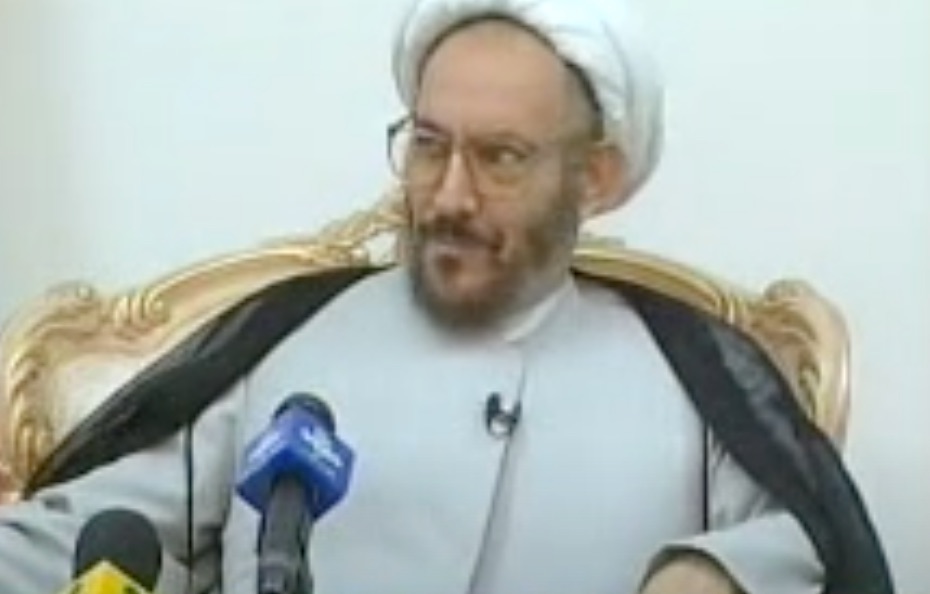
Ali Younesi
Numerous Iranian writers have argued that Iranians were converting to Islam before the Arabian conquest of Iran. They point to the conversion of Salman al-Farisi, a companion of the Prophet Muhammad and the first Persian to become Muslim, as evidence of a broad phenomena of Iranian appeal to the Islamic religion. Moreover, because Yemen was under the control of the Iranian Sasanian Empire when Ali (who the Iranians revere as the successor to Muhammad) preached Islam there, his call to conversion was to the whole Iranian nation.
When the Arabs did invade Iran it was extremely gory. So much so, that the most famous battle in the Arab conquest of Iran is called “the Battle of Blood River” (known officially as the Battle of Ullais). In this battle, Khalid ibn al-Walid, the military commander under Muhammad and the caliphs Abu Bak and Umar, exclaimed a prayer: “O Lord! If you give us victory, I shall see that no enemy warrior is left alive until their river runs with their blood.” In the aftermath of the battle, al-Walid took Persians and their Arab Christian allies to a river where they were slaughtered and their blood flowed like a river. It actually took a day and a half to behead all of the captives. The obstacle for Khalid was that the ravine of blood coagulated and Khalid’s troops were forced to eventually release water into the canal in order that it would run red with the blood of the slain lest Khalid’s vow be left unfulfilled. (1)
With such a horror in the Arab conquest of Iran, how then do the Iranians reconcile their Islamic faith with such a history? They simply look to Ali who they esteem as a man of compassion who treated the Persians as equals unlike Khalid ibn al-Walid, Umar bin al-Khattab and Uthman bin A’affan who believed in Arab supremacy. Iranians believe that they hold onto a mystical Islam unlike their Arab neighbors, and are an intelligent people who recognized the pure teachings of Muhammad. The bottom line of the Iranian-Arab conflict over the religion of Muhammad is truly Arabization versus the Persianate. The Iranians (as Daniel the prophet predicted refuse to Arabize and want an Islam that is free of the ugly aspects of Arabian culture. There is more to Daniel’s prophecy in his Second Chapter than meets the eye of western commentary (2) since the entire structure of the image of gold, silver, bronze and Iron does not exclude Persia (Iran, the silver), especially since these empires collapse at the end of days. In fulfillment, today Iran (Persia) want a more of a non-Arabized mystical Islam fused together with Persian culture and linked to Persian history, and not the Islam of Arabian culture.
Meir Litvak summarizes the struggle against Arabization:
“While Umar (the ultimate evil ruler in Shi’a tradition) disparaged and mistreated the Iranians, Imam Ali and other Imams spoke Persian occasionally as an indication of the respect they had for Iranians and their culture. In particular, they praised the piety and conduct of the people of Qom and Khorasan (Mashhad), the two holy cities for the Shi’a in Iran. Later on, since the Umayyads and Abbasids treated the Iranians as “second rate” Muslims, they were repudiated by the Iranians and had no impact on “Iranian national identity and national essence.” By contrast, the Shi’a Imams became the “refuge of the oppressed,” and their relations with the Iranians had been truly “Islamic and humane,” and they “quenched” the Iranians’ thirst for justice and equality. Moreover, once the Iranians accepted Islam, they looked for the best source to address intellectual and doctrinal challenges and found it in the Imams. In other words, unlike the crude Arabized Sunni Islam, the Iranians saw Shi’aism as the more advanced branch of Islam which corresponded to their thirst for the truth. It was this fusion between Iranian traits and the nature of Shi’aism, which laid the ground for the consolidation of Shi’aism in Iran, and from then on the Iranians supported every Shi’a dynasty that ruled that part of the world.”
The Iranians, says professor Khosrow-Paneh, rejected the Arabian Islam of the Umayyads and the Abbasids, and have established their own Iranian Islamic identity: “Iranians did not accept Umayyad Islam and Abbasid Islam, so they rejected the negative values of ancient Iran. The Iranians merged the positive values of the Iranian nation with the original Islamic values and created an identity that is interpreted as “national-Islamic identity”.”
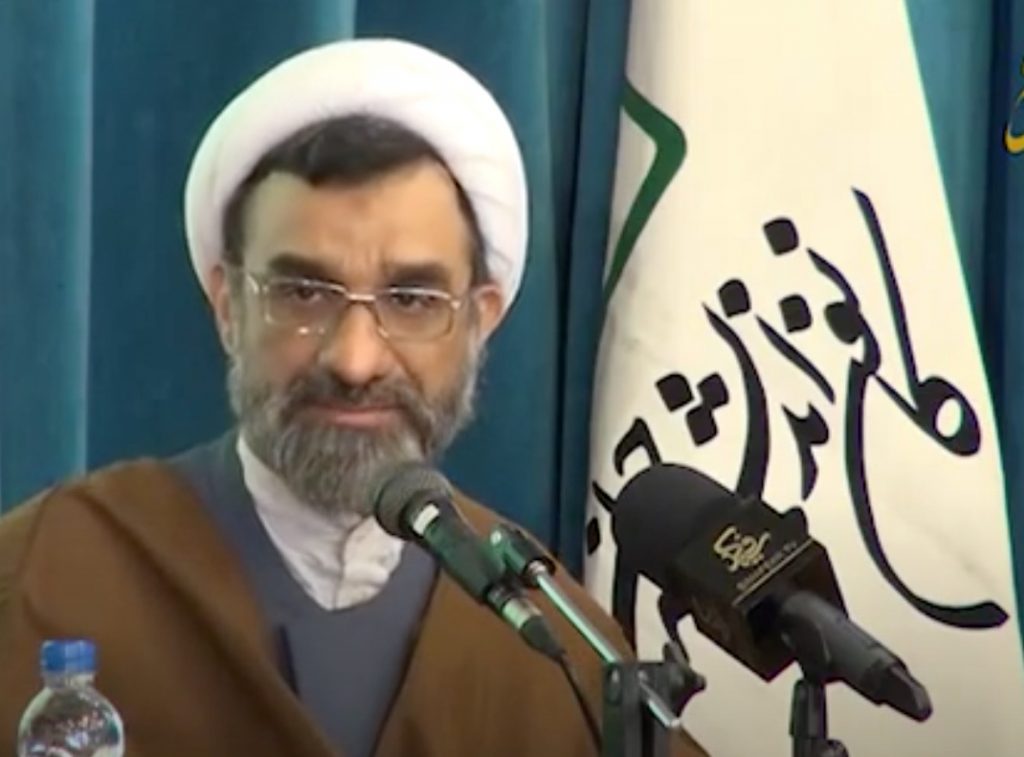
Abdol Hossein Khosrow-Panah
The Iranians want to grip onto the Islamic religion while at the same time holding onto their Iranian identity free of any taint of Arab culture. It is similar to what the Japanese did, absorbing Western technology while at the same time preserving their Japanese culture with its fusion of Buddhism and Shintoism. The resistance of the Iranians towards Arabization was alive and well after the Arabian conquest of Iran. The Persian poet, Ismail ibn Yasar al-Nisai — who worked within the court of the Umayyad Caliphate, spoke of the roots of the Iranian race and the glory of its civilization and history as distinct from Arab culture:
“I swear to your ancestor that I am not weak in defense of my honor!
I have great roots and my glory cannot be compared with others! And my tongue is as poisonous as the sharpness of a sword.
With this language, I support the honor of the original (Persian/Iranian) lineage, who were all great and crowned rulers.
Open commanders and chiefs, border guards, pioneers, chosen benefactors and hospitable
Who, like Khosrow (Anoushirvan) and Shapur and Hormozan, deserves praise and strain!”
Here he praises his ancestry and even goes so far as to exalt Khosrow, a pagan king of Iran who fought the Christian Byzantines in the fourth century; Shapur, another pagan king of Iranian history; and Hormuzan, a Persian military officer who fought the Arab Muslim conquerers of Iran in the Battle of Qadisiyyah. All of these historical figures were not Muslim but a part of the pre-Islamic Iranian religion of Zoroastrianism and fire worship, and thus the words of the poet, al-Nisai, are not about praising Islam but about revering Iranian identity.
This ideology of the Iranians is not entirely Islamic, but really a syncretism between identitarianism and Shia Islamism. There is within the country a strong religion of Iran itself. This was reflected by Esfandiar Rahim Mashaei (an advisor to president Mahmoud Ahmadinejad) when he publicly declared, “We should believe in the idea of Iran, in the ideology of Iran.”

Esfandiar Rahim Mashaei
When Mashaei said this, it sparked outrage from Iran’s conservative establishment who wants Islam to be the dominating belief within Iran and not an ethno-nationalist religion. Mashaei’s statement was a reflection of a growing trend within Iran, one of ethnic pride and nationalist spirituality. This religion of soil ignores the Islamic prohibition of revering other gods and will praise artifacts of Iran’s pagan past. In 2010 Ahmedinejad saw the Cyrus Cylinder, an ancient text praising Emperor Cyrus as being chosen by the pagan god Marduk, as it was in display in Tehran (this was after almost a decade of Iran working to convince the British to bring it to Iran). The cylinder describes how “[Marduk] inspected and checked all the countries, seeking for the upright king of his choice. He took the hand of Cyrus, king of the city of Anshan, and called him by his name, proclaiming him aloud for the kingship over all of everything.”
Yet — despite the standard Islamic boasting of how the paganism of pre-Islamic lands was crushed by the Quran — Ahmedinejad described the cylinder as a “testament of all believers” and the standard by which “all rulers and kings in the history of humankind” must be measured. This adulation for pre-Islamic Iranian civilization is an ideology that reflects a political mission. The Iranians have a dream of reviving the Persian Empire, and Ahmedinejad’s lifting up of the Cylinder reflects this aspiration, since the ancient text reads: “I am Cyrus, king of the world, great king, powerful king, king of Babylon, king of Sumer and Akkad, king of the four quarters [of the earth], son of Cambyses, great king, king of Anshan, descendant of Teispes, great king, king of Anshan, the perpetual seed of kingship, whose reign Bel [Marduk] and Nebo love, and with whose kingship, to their joy, they concern themselves.” When Isaiah foretold of the end of things — “Bel bows down, Nebo stoops” (Isaiah 46:1) — no longer should this puzzle interpreters; how could an ancient Mesopotamian religion revive? Indeed, today the Iranian government praises an ancient artifact worshipping Bel and Nebo.
Iran wants to be like Cyrus, while ruling the world under the banner of Shia Islam. In 2018 there was a concert in Iran of a Shiite song entitled Nohe, in which the singer firmly patted the Shiite flag while singing: “This is the Shia flag that will be waved from the top of the world.” But, as Ahmedinejad’s praise of the cylinder indicates, this revived Persian power would not be entirely Islamic, and would contain the reverence of country and even the pagan roots of the nation. In Iran, pagan holidays are still celebrated. Iranians still observe Chaharshanbe Suri, a celebration of fire (which was worshipped by pagan Iranians before Islam) in which Iranians hop over flames.
Iranians still celebrate Nowruz, a festivity of the new year in dedication to nature. In fact, Iranian tradition teaches that the 12th Imam will appear before humanity on the day of Nowruz.
The insistence of the Iranians to preserve these festivities is another way of defying Arabization. The Iranians see themselves as having an Islam purer than that of the Arabs. This was also reflected by the Persian writer Musa ibn Yasar who said: “The companions of the Messenger of God (PBUH) were violent deserters. When we Iranians came, we purified the religion of Islam.” The Iranian newspaper, Kayhan (which is connected to the Iranian government), states that the Arabs — before Islam — were a “cruel and uncultured people” who lacked any understanding of written theology and laws, and were a people who had never witnessed a true prophet, and had been vacuous of divine and heavenly faith and belief.
If the Arabs did not receive Islam from a fellow Arab — so the newspaper teaches — then they would have never accepted Islam. The Iranians, on the other hand, were sophisticated enough to look past language differences and recognize spiritual truths. According to Iranian propaganda, the Qu’ran and the Prophet recognized the Iranians as a “God-fearing people, courageous and firm in their belief and possessing God-given intelligence and aptitude,” and praised their character traits as those of “the Party of God” (Hizballah). Iran sees itself as the true defender and preserver of Islam. This is reflected by Iran’s constitution which depicts the Supreme Leader as Vali amr al-Muslimin (Guardian of the Muslims) or in the official English translation “Supreme Leader of Muslims”. In 1995, Hassan Rouhani (who was at the time the head of the Center for Strategic Studies of the Expediency Council) declared that “The eminent leader of the Revolution, his eminence Ayatollah Khamenei, may his shadow extend, is the leader of the world of Islam today. This has nothing to do with whether we say so or not.” General Qassem Suleimani, the late commander of the Quds forces, boasted that thanks to the Islamic Revolution, “no country but Iran can currently claim leadership of the Islamic world.”
The Iranian philosophy professor, Abdol Hossein Khosrow-Panah, stated in 2009 that Sunni Islam had been hijacked by Caliphal (Caliphate) Islam and that the spirit of the religion of Muhammad was corrupted by the Arabized Caliphate to the point that the term Islamiyat was connected with Arab tribalism and chauvinism. In an interview, Khosrow-Panah explained: “Sometimes the meaning of Islam is the Islam that became the current of the caliphate and the period when the spirit of Islam fell victim to the Arab caliphate, so much so that if we talk about Islam, we mean the spirit of tribalism and ethnic-Arab pride.” Iranian ideologues like to point to a Hadith in which the Prophet Muhammad warned the Arabs that if they turn away from Islam, Allah “will replace you with another people who are not like you.” The Iranians hold that the people that replaces the Arabs are the Iranians because when the companions of Muhammad asked him to specify who these new people were to be, he replied: “If faith is in Soraya, a group of Persian men will acquire it.”
Others have even argued that the reason why Islam was so widely accepted in Iran is because of the similarities between pre-Islamic Iranian religion and Shia Islam, such as the ritual self-mutilation within the Shiite religion (Ashura) and the religious self-cutting that was done by ancient Iranians. Within the paradigm of Iranian nationalism is the belief that Iran threw away the corrupt elements of pre-Islamic Iranian culture while adopting pure Islam without the primitive aspects of Arabian Islam. The synthesis of pre-Islamic Iran with Islam was seen when Khamenei sought to nationalize the hijab. Before Iran was Islamic, there was a headscarf in society called the Chador, but it was only worn by elite women. Khamenei simply Islamized the Chador and argued that what was once only allowed for prestigious women can now be enjoyed by all women thanks to the democratic ways of Islam. The Chador, Khamenei declared, is “our national symbol and national garb”.
IRAN AND GERMANY
In Iran, there is even a phenomena of people believing in Iranian supremacy, revering their race as that of the Aryan heritage, a parallel ideology to Nazism with its emphasis on Aryanism. Khosrow-Paneh spoke of these racialists, stating that “some secularists and those who have ancient tendencies and emphasize Aryanism usually offer this interpretation of Islam.” There is definitely a racial element within Iranian nationalism that has become mainstream, and this is expressed by the belief that the reason why Iranians have a superior form of Islam to the one of the Arabs is because of something biologically innate within the Iranian people themselves. Khosrow-Paneh explains this eugenic ideology: “But there are also people who have linked Iranian national identity to truths that go back more to human instincts. … It seems to me that there is an innate feature and attribute in the human body that implies justice and truth-centeredness. But the most important factor that made Iranians accept pure Islam and oppose Umayyad Islam was their innate characteristics. …Those characteristics of Iranians, as I said, go back to the natural characteristics of Iranians.” The synthesis of Shia Islam and Iranian nationalism amalgamates into a religion of blood and soil that rages against both the Arabs and the Jews. This, as well, can be heard in the apocalyptic song, Nohe, when the singer proclaims:
“We hear the shouts of the world-eating Jews from the throat of the Saudi King … For as long as the divine spirit is in the heart of this soil (Iran), Our enemies will not be allowed to sleep a single restful night … Our Seijjil Missiles will drop in the heart of Tel Aviv.”
Here we have the praise of Iran as being a sacred land, ready to wipe out her enemies — the Arabs and the Jews — in World War Three. These Iranian nationalist fanatics are subscribing to a blood and soil ideology, something paralleled to Nazism. The National Socialist writer, Hansjoerg Maennel, who wrote for the Third Reich, spoke of the soil of Germany being divine: “As our Germanic forerunners already recognized, blood and soil are eternal and holy values. … And eternal too is the soil, hallowed by the blood poured forth in its defense.” And just as the Germans wanted to exterminate the Jews, these Iranian Shiite cultists long for the day when missiles “will drop in the heart of Tel Aviv.” And just as the Germans were fixated on being “Aryan,” today’s Iranian nationalists are no different, looking back to a distant past and mythologizing their “Aryan” roots.
This has been something quite prevalent in modern Iranian history. For example, in 1965 Mohammad Reza Shah gave himself the title of ariyāmehr, “the light of Aryans”. Reza also told the British ambassador Anthony Parsons: “We Aryans are in fact members of the European family. It’s a mere accident of geography that Iran is in the Middle East rather than among its fellow European neighbours”. This fixation on Aryanism did not diminish nor remain stagnate, but has continued to intensify. Iranian historian, Reza Zia-Ebrahimi, wrote in his 2016 work, The Emergence of Iranian Nationalism, on this bizarre obsession:
“New publications with strong dislocative nationalist overtones appear every year. The greater number of these recent publications is startling when compared to the literary works of the early Pahlavi era or the history treatises of the same period. Anyone familiar with dislocative nationalist literature can notice that these publications are highly repetitive, merely recycling the works of Akhundzadeh, Kermani, and their heirs. There is something new, however, and this is their generally appalling quality and their outlandish claims. Any inaccuracy, any nonsensical theory is admissible as long as it fits into the strategy of discursively soothing the reader’s concerns with the state of the country, fundamentalism having replaced backwardness as the main malady of modern Iran. Some authors today attempt to establish Aryan calendars or claim that ancient Iranians had space-faring ships. We have come full circle as these new publications have abandoned the little methodological soundness that one could find in Pahlavi-era dislocative treatises and returned to the preposterous inventiveness of a Kermani. This is all the more ironic for our time, as Iranians have never been as literate as today, and empirical data has never been as readily accessible.”
So the dangerous obsession with being Aryan still thrives in Iran, and its right amidst a flaming rage to wipe out the Jews. In other words, Iranian Nazism is very strong. It is no wonder that, after the Second World War, Nazis from the the Third Reich found refuge within Iran and gained prominent positions in the government. It is also not to our surprise that the Iranian government, for decades, has wanted to see Germany revive her power in Europe.
In 2006, Mouhmoud Ahmadinejad, in an interview with Der Spiegel, posed the question to the interviewer that out of the 60 million people who died in the Second World War, why “are only the Jews the center of attention?” The interviewer wanted to avoid the subject and said: “perhaps we should now move on to the next subject.” But Ahmadinejad was adamant: “No, I have a question for you. … Why must the German people be humiliated today because a group of people committed crimes in the name of the Germans during the course of history?” Such a statement could have easily come out of the far-Right German nationalist party, Alternative for Deutschland (AfD).
The words of Ahmadinejad are reminiscent to that of AfD leader Bjorn Hocke, when he lamented in 2017 that Germans were “the only people in the world to plant a monument of shame in the heart of its capital,” referring to a memorial to murdered Jews in Berlin, adding that Germans had the “mentality of a totally vanquished people.”
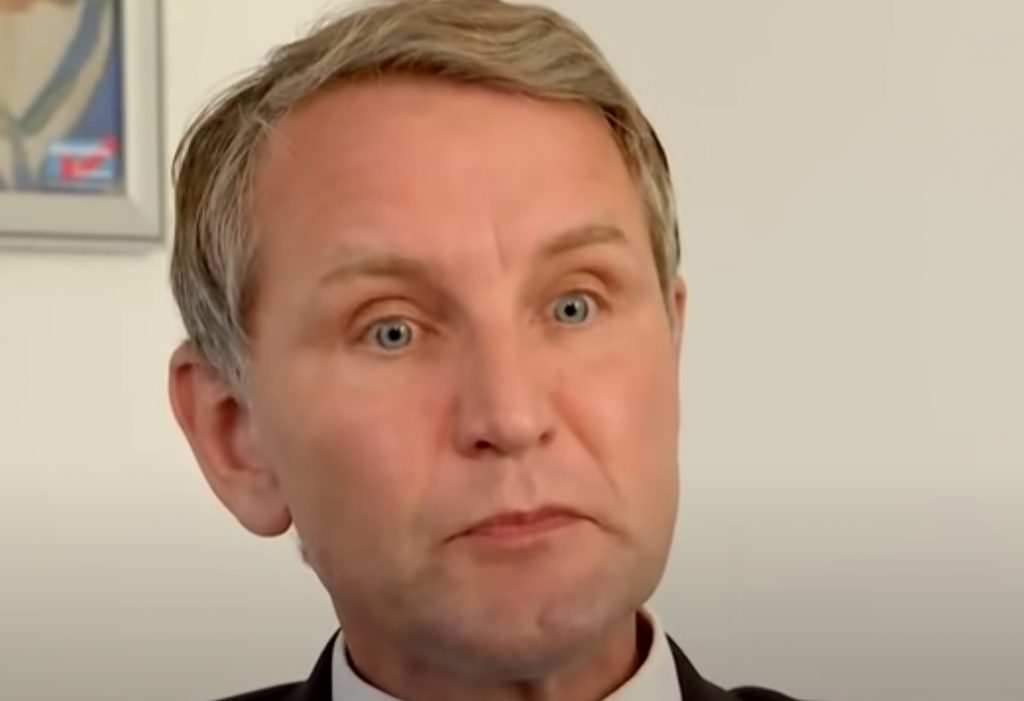
Bjorn Hocke
The beliefs of Iranian nationalists and German nationalists are the same when it comes to any focus on Germany’s past atrocities: they want them to be belittled or reduced to mere nominal attention. All of these people, of course, are bent on erasing the blood soaked history of what happened to the Jews. For those who wish for massacres to be forgotten want to simply repeat those very inhumanities. There has been a desire within Iran to see Germany revive herself. In the early 1950s, the popular Islamic preacher, Abol-Ghasem Kashani (who had been a major supporter of the Nazis in Iran) had expressed his desire to allow Germany to remilitarize itself. After the 1979 Iranian Revolution, Kashani (who was by then dead) would be a famous icon for the mullahs’ regime.
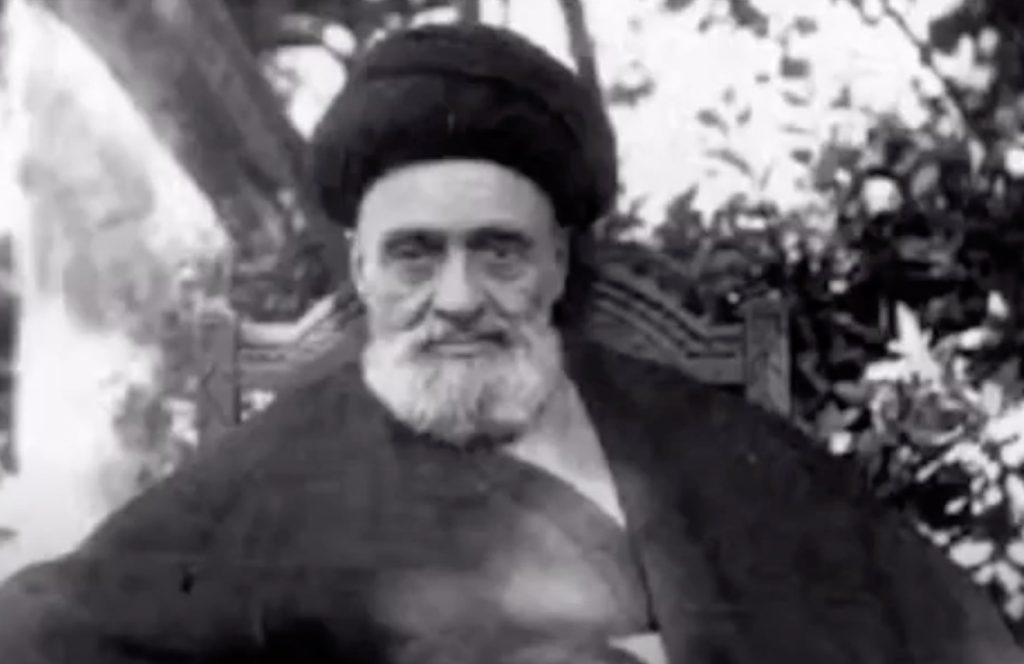
Abol-Ghasem Kashani
In 1972, Shah Mohammed Reza Pahlavi, expressed his desire for a revived Germany to German Chancellor Willy Brandt. In his notes Willy Brandt recounted how the Shah and his government “still regard Germany as a great power. They think that we should put the ‘guilt complex’ stemming from the Hitler period behind us and that we could assume the leading role in Europe.” In Germany today there is a complaint about how looking after the country’s national interest is demonized. This ‘demonization’ is, of course, due to the Holocaust, and thus the militarists of Germany want to cast away this stigma and allow for Germany to remilitarize, even going so far as calling for the country to have nuclear weapons. In August of 2018, the influential political scientist, Christian Hacke, wrote of how the “demonization of national interest has led the European Union into a dead end and deep crisis”; and how that in “the face of new transatlantic uncertainties and potential confrontations, national defense based on an independent nuclear deterrence capacity must be given priority.”
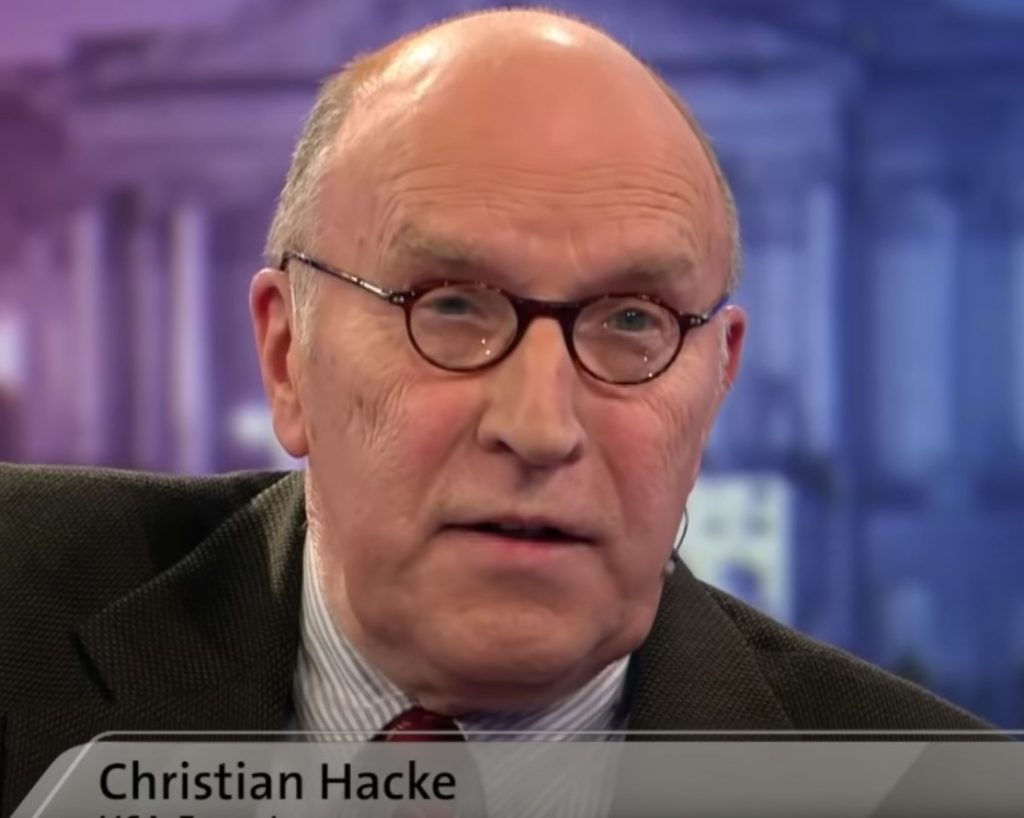
Notice the words Hacke is using: “transatlantic uncertainties” — he is referring to the United States no longer being reliable to deal with Germany’s security, and thus the Germans must have nuclear weapons. Both Germany and Iran are at tensions with the US; both are resistant to American control, both are seeking to become global powers, and both want to go nuclear.
The Iranians in the 50s and 70s wanted Germany to forgo its guilt and remilitarize itself into a great power again. Today, this Iranian dream is gradually becoming a reality. And Germany is pursuing national autonomy, in part, because of its desire to continue relations with the Iranians in spite of the Americans’ pressure on Europe to end commerce with Tehran. This desire for autonomy — in the name of preserving economic ties with Iran — has intensified to the point that rhetoric for replacing the US with Europe has been exclaimed. In 2018, Jean-Claude Juncker (who was then the president of the EU Commission) lamented that the US “no longer wants to cooperate with other parts in the world,” and concluded: “At this point, we have to replace the United States, which as an international actor has lost vigor, and because of it, in the long term, influence”.
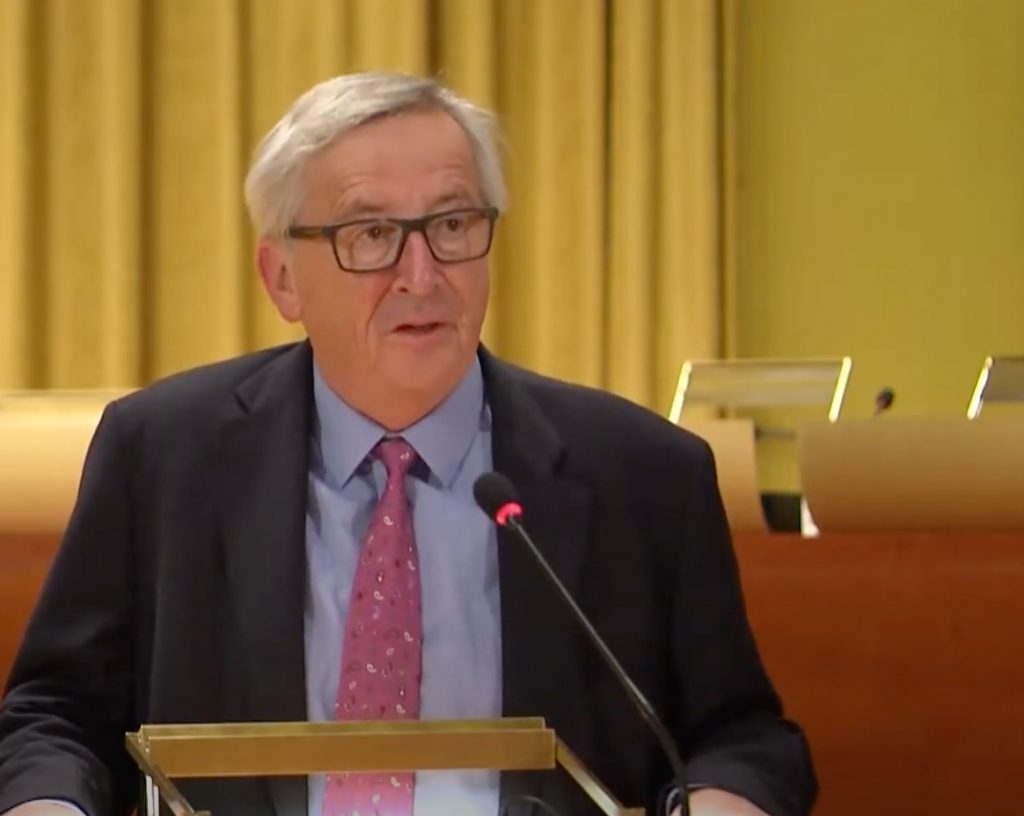
Jean-Claude Juncker
A revived German empire has been a deeply rooted dream amongst Iranian nationalists. On August 4th, 1954, an anonymous Iranian dropped a note to the doorman which stated: “Hail Germany and the German people, death to your enemies who did not want you to stand up.” The note then went on to compare the situation of Germany to that of Iran: “Death to your enemies,” because the countries — Britain, the Soviet Union, and the United States — that had occupied Germany in 1945 did not want Iran to “stand up” either. So strong was sympathy for the Third Reich in Iran that the American Office of Strategic Services on June 23rd of 1945 reported how there was “a tendency to sympathize with rather than condemn those who have aided the Axis”. This sentiment in favor of the Third Reich was so ubiquitous that major German Nazis who worked with the Iranians during the Second World War were still collaborating with Iran after the war. In December of 1952 a new German-Iranian Chamber of Commerce was established in Hamburg’s Atlantic Hotel, and “almost all the founding members of 1936 were reunited and assembled,” as was reported in Orient magazine.
The organizer of this Chamber of Commerce was Reinhard Hubner, who was the Eastern affairs expert in Goebbel’s Propaganda Ministry while at the same time being the secretary for the 1936 German-Iranian Chamber of Commerce. West Germany’s first postwar ambassador to Iran was Lutz Gielhammer who — between 1934 and 1938 — was the head of the Central Economic Department for Iran’s Melli Bank. After 1938, Gielhammer was a member of the Central Financial Management of IG Farben (the Nazi ran pharmaceutical company heavily involved in human experimentation and slavery). On September 3rd of 1953, Gielhammer was appointed to be ambassador to Iran. In 1952, the Iranian government under Mossadegh appointed as their economic advisor the very person who served in Adolf Hitler’s government as President of the Central Bank (Reichsbank), Hjalmar Schacht, who was sent by Hitler himself to go to Iran and sign the Clearing Payments Agreement after which Germany made substantial investments in Iran’s industrial infrastructure.
The Mossadegh government of the 1950s also wanted to remove all British experts in Iran’s oil industry and replace them with Germans. In 1951 over four hundred Germans applied for the oil work, but the plan was stopped when the British representative on the High Commission that controlled West Germany vetoed the move, after which (as Ahmad Mahrad writes) “the federal minister for the economy asked the chairman of the Oil Association in Hamburg to halt the departure of 450 applicants.”
After the overthrow of Mossadegh in 1953 (a revolution that was facilitated by the CIA), the new prime minister of Iran was General Fazllollah Zahedi, who was a close collaborator with the Abwehr (the German military intelligence service for the Wehrmacht from 1920 to 1945) and the SD (Sicherheitsdienst, the intelligence unit for the SS and the Nazi Party) during the Second World War and, as a result, was arrested by the British in 1942. A 1953 report from Der Spiegel asks the question that if Zahedi revolted against Mossadegh with CIA support, “then this would not have been the first time in postwar history that former German contacts had transferred their loyalties to the Americans.” Indeed, during the Cold War the United States was backing Nazis and ultra-nationalists in Europe (including Turkey’s Grey Wolves paramilitary cult) as anti-Soviet proxies; this was under the Gladio operation and its obvious that such a policy extended into Iran.
Thus, it is not to one’s marvel that Bernhardt Schulze-Holthus, who served as an Abwehr agent, praised Zahedi’s coup as an anti-communist popular uprising and compared it to the German nationalist “uprising” of 1941-44 (the years when Nazi Germany was at war with the Soviet Union). As a result of the 1953 Revolution, General Fereydoon Batmanghelidj became the new chief of staff. Batmanghelidj was trained at the German technical school and was considered “very pro-German”. This was certainly revealed in a 1953 meeting with a German Embassy official to whom Batmanghelidj (holding a book on General Rommel) emphasized his wish “to employ German experts in the Iranian army.” He explicitly requested German experts who worked for the Third Reich and who would thus form a “counterweight to the Americans” inside Iran’s military. So here we see the Iranians working with the Germans to bypass American control.
Similarly, today we see Iran working with Germany in spite of the US’s pressure to not work with Tehran. Hence why Germany’s Federal Foreign Minister, Heiko Maas — speaking on business with Iran — wrote that it is essential “that we strengthen European autonomy by setting up payment channels that are independent of the USA, creating a European Monetary Fund and building an independent Swift system”. Germany wanting to bypass American oversight to collaborate with Iran is not new. When Batmanghelidj made the request to the Germans for Nazi military experts in 1953, the German Foreign Office did not deny this request, but rather sought to meet this demand without consulting the Americans or the British.
Going all the way back to the 1920s, Germany has been in economic relations with Iran. After the Second World War, West Germany revived economic ties with Iran in 1949 and from then on it has been, for the most part, continuously growing. Just to show you how deep Germany has been in Iran’s economy, according to Abolfazl Adli, from 1952 to 1959, West Germany was “the leading supplier of metal goods, machines, electrical goods and appliances, and motorcycles, and was in second place for cars, buses and bicycles” in Iran. By 1952 West Germany had replaced the US as Iran’s number one trading partner. Germany held this position until 1972 (when it was overtaken by the US), but went back to being Iran’s biggest trade partner in 1979. But even before 1979 Germany’s economic ties with Iran were huge. “West Germany’s economic ties with Iran are closer than with virtually any other non-European country” wrote Der Spiegel in 1975.
But currently trade between Iran and Germany has declined due to US pressure through sanctions. Reuters reports that “German exports to Iran fell by nearly half in the first six months of 2019 … suggesting companies are scaling back business ties with Tehran to avoid trouble with the United States after Washington reimposed sanctions.” Regardless of this, Germany still remains Iran’s biggest trading partner in Europe. In the midst of a growing Iranian nationalism that wants to see the destruction of Israel, with a reviving Germany (the only country to have almost exterminated the Jews) that wants to eclipse American power and desires to pursue ties with Iran, it makes one wonder if Germany will ever want to resume the Holocaust with Iran by its side.
NOTES
(1) Abu Jafar Muhammad ibn Jarir At-Tabari, the early Islamic historian and theologian recorded this event “Khalid said, ‘O Allah, if you deliver their shoulders to us, I will obligate myself to You not to leave any one of them whom we can overcome until I make their canal run with their blood.’ Then Allah defeated them for the Muslims and gave their shoulders to them. Khalid then commanded to his herald to proclaim to his men, ‘Capture! Capture! Do not kill any except he who continues to resist.’ As a result the cavalry brought prisoners in droves, driving them along. Khalid had detailed certain men to cut off their heads in the canal. He did that to them for a day and a night. They pursued them the next day and the day after, until they reached the Nahrayn and the like of that distance in every direction from Ullays. And Khalid cut off their heads.” Also see At-Tabari, Vol XI, The Challenge to the Empires, In series: The History of at-Tabari, (Ta’rikh al-rasul wa’l-muluk), Translated by K.Y. Blankkinship, SUNY series in near Eastern Studies, Bibliotheca Persica, State University of New York Press, Albany New York, 1993, p.44-45
(2) Daniel’s structure of the four metals included the gold (Babylon), silver (Persia), the bronze (Asia Minor), and they are all destroyed by Christ (the rock cut without hands). It is logical, then, to conclude a revival of these ancient empires. Western students focus on Daniel 2:41 which points to the nature of the two materials (Iron and Clay) as being partly weak and partly strong, but verse 43 is rarely addressed in full: “And in that you saw the iron mixed with common clay, they will combine with one another in the seed of men; but they will not adhere to one another, even as iron does not combine with pottery.” The other meaning of this riddle in this verse needs to be noted; the underlined words “mixed” and “combine” are actually the same words translated differently from the Aramaic, the original language of much of the Book of Daniel. The word is actually “Arab.” Strong’s Concordance confirms this “mArab {ar-ab’}; from ‘`arab’ (6150) in the figurative sense of sterility; Arab (i.e. Arabia), a country East of Palestine: –Arabia.” “or mereb (1 Kings 10:15), (with the article prefix), {eh’-reb}; from ‘`arab’ (6148); the web (or transverse threads of cloth); also a mixture, (or mongrel race):–Arabia, mingled people, mixed (multitude), woof.” And thus this passage can read: “And just as you saw the iron mixed with baked clay, so the people will be mixed (Arabized) with the seed of men (through intermarriage) and will not remain united, any more than iron does not mix with clay.”
THOUGHTS ON THE RISE OF NAZISM IN GERMANY
“May God enlarge Japheth,
And may he live in the tents of Shem”
(Genesis 9:27)
When Japheth — the patriarch of all Europeans — leaves the tents of his brother Shem, he slays his brother. Noah declared: “Blessed be the Lord, the God of Shem” (Genesis 9:27), for it was from the line of Shem whence Christ came. Thus when Japheth resides in his brother’s tent, he has civility, but when he leaves, he is ferocious and seeks to burn down the tent of Shem. The world saw this in the Holocaust, and now that the world is turning against the Jews, the question lies: will Germany take part in the future holocaust?
As the wood of the vine among the trees of the forest, which I have given to the fire for fuel, so have I given up the inhabitants of Jerusalem; and I set My face against them. Though they have come out of the fire [the first Holocaust], yet the fire will consume them [the final holocaust]. Then you will know that I am the Lord, when I set My face against them. So I will make the land desolate, because they have acted unfaithfully,’” declares the Lord God. (Ezekiel 15:6-8, brackets mine)
One December 13 of 2021, the German Institute for International and Security Affairs, published a series of papers under the umbrella title of German Foreign Policy in Transition. One of the papers was entitled, The Need for New Concepts to Address Conflicts in Europe’s Broader Southern Neighbourhood, and was written by Hürcan Aslı Aksoy, Wolfram Lacher and Muriel Asseburg. In this paper Asseburg refers to Russian intervention in other counties — such as Libya and Syria — as a response “to the partial retreat of the American hegemon”. This sort of talk has been growing popular in German political rhetoric, that America’s hegemony is declining, and therefore Germany must become a serious military power to defend Europe. Asseburg’s paper goes beyond just mere defense; she goes so far as to say that Germany should focus not just on Europe, but on the Middle East, in the sense that Germany could enter other countries to bring war criminals to justice.

Muriel Asseburg
The realm outside of Europe that is of interest for Germany in stopping war crimes, according to Asseburg, is the “broader Southern neighborhood,” which includes the Middle East, specifically “suspected war crimes in the Palestinian territories”. Asseburg puts forth the criticism that “interventions by regional powers that are not guided by principles of international law, as well as polarisation in the UN Security Council, today place much tighter constraints on international criminal justice than was the case in the 2000s.” Since there are countries that intervene which do not abide by international law (she is obviously referring to Russia) and since the UN is not reliable to stop war criminals and bring them to justice, Germany can be a pioneer in different way towards getting rid of war criminals. “Effective conflict transformation in the broader Southern neighbourhood”, writes Asseburg, “is in Germany’s own interest in order to avert negative repercussions and provide a convincing alternative to the offers of illiberal actors.”
To bring these war criminals of the neighboring South to justice is not something that the International Criminal Court can be relied upon to do, Asseburg writes, and so national courts (such as the German court) must step in: “prosecution by the International Criminal Court (ICC) or international special tribunals is often impossible because permanent members of the UN Security Council are involved. Therefore, the only option is for national courts to deal with the situation in accordance with the principle of universal jurisdiction.” To help solve this, Germany can take a pioneering role “by encouraging trials under the principle of universal jurisdiction in national courts (in Germany and other EU member states where this is possible)”, meaning Germany can intervene against war criminals and bring them to justice in a German court. Germany can also go against war criminals “by expanding the capacities of its own law enforcement agencies”. And when speaking of stopping war crimes, Asseburg speaks of the Palestinian territories: “Germany can only credibly act as a pioneer if it consistently fulfills this role. This implies that criminal prosecutions do not stop with the nationals of friendly states (see, for example, the ICC investigation into suspected war crimes in the Palestinian territories)”.
There is an interesting — and odious — trend that is building up within Germany: the care for the Holocaust, or the concern over the sensitivities around the Holocaust (or Shoah) is going down in Germany. This has been taking place for years without much attention. I remember when I was a sophomore in high school around 2005, I had a history teacher who had taught in Germany for some time, and I recall her telling me how the youths in Germany were tired of hearing about the Holocaust. This trend is very real, and has even been acknowledged by Germany’s foremost Middle East scholar, Muriel Asseburg who, in a 2015 interview, spoke of a “a gradual shift” in which Germany is not “automatically on Israel’s side” and that the care to remember the genocide of the Jews orchestrated by Germany is no longer as big as it once was:
“There is at least a gradual shift here, but so far no fundamental change in Berlin’s attitude. It is no longer the case that Berlin is always automatically on Israel’s side; a common European stance often takes precedence here. … While the significance of the Shoah [Holocaust] in the minds of citizens in Germany is decreasing, it remains a very strong constant in the Israeli education system. Accordingly, it powerfully underpins the desire to never want to be a victim again.”
What Asseburg is saying is that while Israel doesn’t want another Shoah to happen again — and thus why it uses strong military responses — the Germans don’t care so much about the Holocaust anymore. So, what we have is an Israel that focuses on the Shoah and wants to prevent another through a robust military, and a Germany that doesn’t care so much about it. It is very strange to even be talking about such a situation in which Germany doesn’t care so much about the Holocaust. The Germans conducted the greatest massacre of the Jews in history — they were the closest to ever fully exterminating Europe’s Jews — and this dark page of history does not bother the Germans as much. This should, in the very least, bother us. Asseberg spoke of Germany’s growing indifference to the Holocaust in an interview in 2015. This was the same year that the German Bertelsmann Foundation did a survey on views on Israel and the Holocaust in Germany. 48% held a negative view of Israel, including a majority of those in the age group of 18 to 29. 55% of respondents agreed with this statement: “Today, almost 70 years after the end of the war, we should no longer talk so much about the persecution of the Jews, but should finally draw a line under the past”.
The majority of these particular respondents were amongst the younger generation (67% of Germans under the age of 40), while amongst older Germans its 51% who agree with the above statement. In the youngest age group (18 to 29 years old), almost 80 percent said they were annoyed by discussion on the Holocaust. A total of 81 percent of German respondents agreed with this statement: “one should let history rest and focus on current or future problems”. These numbers were later reflected in 2017 when a German nationalist book entitled Finis Germania (The End of Germany) and written by historian Rolf Peter Sieferle, was published. The book was published after Sieferle killed himself in 2016, and with the fame of his death, his book sold very well, selling 250 copies an hour, according to its publisher, and ranking No. 1 on Amazon’s German best-seller list, a position it held for almost two weeks (altogether, its first edition sold 20,000 copies in a matter of weeks). The book addresses itself against what Sieferle sees as the “cult” of the Holocaust. The Jews, says Sieferle, received forgiveness for murdering Christ, but the Germans will never get forgiveness for the Holocaust. Sieferle was embittered by what he saw as the world holding the Jews up to a position of moral superiority, and deeming the Germans as forever damned:
“Today, the Jews, to whom God himself had promised eternity, build memorials throughout the world to their murdered coreligionists. Not only are the victims ascribed a moral superiority, the wrongdoers and their symbols are ascribed an eternal depravity.”

Peter Sieferle
He also stated in regards to the Holocaust: “National Socialism , or more precisely Auschwitz, has become the last myth of a thoroughly rationalized world. A myth is a truth that is beyond discussion”.
Sieferle loathed the continual reminder of the Holocaust, and even mocked it, saying that murdering six million Jews was a record meant to be broken:
“What can you learn from Auschwitz? That modern technology is used for mass murder in the modern era? Anyone who is surprised by this should learn from Auschwitz. Or is it the sheer number of victims, the ominous six million? So something for the Guinness Book of records? But be careful, records are there to be broken.”
If the leviathan that is Germany was put down after World War Two, then how could such a book become a best-seller? In the groundswell of Germany there is a growing feeling of ire towards the stress on the Holocaust: people are tired of hearing of it, and they mordantly say things such as, ‘When will we Germans be finally seen as redeemed from this past event? When will we be pure?’ This way of talking has been heard not only from those who are against taking in non-European migrants, but also from those who support the “Boycott, Divest and Sanction” Israel movement (BDS). These people want Germany to boycott Israeli products, and to sanction and no longer invest in Israel. The German parliament has condemned the BDS movement as antisemitic, and this move was seen as influenced by the emphasis on the Holocaust. Muriel Asseburg said in an interview in June of 2023:
“I believe that it has a lot to do with our perspective on this conflict … i.e. the German perspective and above all the German political perspective is extremely influenced by our past and how we try to come to terms with our past”.
In the same interview, Asseburg speaks in a sardonic way that eerily echoes someone like Sieferle when he wrote that the Germans “are ascribed an eternal depravity”. Asseburg cynically said that the Germans have been “cleansed” of their crime — the Holocaust — because Germany gave the Israeli government the power to purify:
“We are cleansed, we, those responsible for the Holocaust, are cleansed and we have given the Israeli government and a few other institutions the power to decide whether that is the case or not.”
The fact that figures such as Asseburg speak in such a way, and the fact that a book such as “Finis Germania” became a bestseller, tells us that a cynical view of the Holocaust has become mainstream in German society. This is also clear in the political realm. The German nationalist party, Alternative fur Deutschland (AfD), hit an all-time-high approval rating of 22% in election polls in July of 2023. The AfD is now amongst the largest parties in Germany, and it is full of politicians who have quite a bleak view of the Holocaust. In October of 2022, AfD politician Holger Winterstein sparked outrage after a photo came out showing him appearing to dance on top of the Holocaust memorial in Berlin. Alexander Gauland, a major leader of the AfD, referred to the Holocaust as a “speck of bird poop” in Germany’s history, stating that “We have a glorious history and it, dear friends, lasted longer than those blasted 12 years”. This conveys quite simply a ubiquitous feeling in Germany: ‘we are tired of talking about the Holocaust.’ Bjorn Hocke, probably the most famous of AfD’s leaders, exclaimed before an ecstatic crowd for the party’s youth branch: “our state of mind, is still that of a totally defeated people.” In other words, ‘we are still stuck talking about the Holocaust, and it is undermining us, weakening us.’ He then attacks the Holocaust memorial, expressing how sick of it he is: “we Germans, that is, our people, are the only people in the world who have planted a monument of shame in the heart of their capital.” He later affirms that the continual emphasis on the Holocaust has paralyzed Germany:
“Coming to terms with the past as a permanent task for society as a whole paralyzes a people. And this stupid coping policy paralyzes us even more today than in Franz Josef Strauss’ time. We don’t need anything other than a 180 degree turn in the politics of remembrance!”
Hocke deemed remembrance for the Holocaust as a “dead rite” and called for a renewed awakening for German pride:
“We don’t need any more dead rites in this country. We no longer have time to execute dead rites. We no longer need empty phrases in this country, we need a living culture of remembrance that, above all, brings us into contact with the great achievements of those who came before us.”
Bjorn Hocke
This new sense of patriotism, according to Hocke, should be enforced:
“In short: It’s about giving the newly created facades, here in Dresden, but also Potsdam, and in Berlin the city palace is currently being rebuilt – thank God it’s being rebuilt – it’s about giving these newly created facades a new, worthy appreciation to breathe spirit. It is the spirit of a new, honest, vital, deeply founded and self-confident patriotism. Because we know: Without such a new patriotism, no civil society can survive. … But we dare to demand this inner renewal. Not only do we dare to demand it, no, dear friends, we will also enforce it for the sake of our dear fatherland.”
Indifference towards the Holocaust will enable the revival of the German reich. As the past is ignored, so is the repetition of the past. For, in an ahistorical society, a warning about a repeat of past evils is received by deaf ears. In September of 2023, the historian on the Holocaust Christoph Kreutzmuller did an interview in which he was asked if he found the resurgence of the German right surprising, to which he replied:
“No, I mean, there’s more than one factor. One is that history is long gone now. People have forgot what it really [was] like in Europe. The witnesses are dying — the eyewitnesses — and so the impact is dying. It’s not just like the witnesses of the persecuted, it’s the people… who can say, ‘Look, my village has been bombed, and it was dreadful.’ That is kind of receding, this acute knowledge of destruction and murder.”
What makes the rise of nationalism even more concerning is that it is happening at the same time when the idea of Germany’s military becoming more independent of US power is growing in popularity. Bjorn Hocke, in his 2017 speech, echoed this sentiment:
“Our once respected army has degenerated from an instrument of national defense into a comprehensive, multicultural reaction force in the service of the USA.”
This opinion is closer to, than it is far away from, the mainstream. What Hocke is saying echoes a greater desire for military independence and strength within Germany. In October of 2023, Germany’s defense minister, Boris Pistorius, said something in regards to the military that is not commonly heard:
“We have to get used to the idea that there could be a threat of war in Europe … We have to become ready for war. We have to be defensive. And prepare the Bundeswehr and society for this.”
The striving for military willpower is not wanted simply for within German borders; rather, it widens to a greater European military strength. In September of 2023, German chancellor Olaf Scholz mirrored this yearning for a powerful Germany being the leading bulwark for Europe:
“As the most populous country with the greatest economic power and as a country in the middle of the continent, our army must become the cornerstone of conventional defense in Europe: the best-equipped force in Europe”
In a 2016 speech in Strasbourg , the head of the EU Commission, Jean-Claude Juncker, called for a pan-European military independent of the US:
“Europe can no longer afford to piggy-back on the military might of others or let France alone defend its honour in Mali. We have to take responsibility for protecting our interests and the European way of life.”
In a 2018 speech for the Flemish regional parliament, Juncker was much more extreme in his words:
“At this point, we have to replace the United States, which as an international actor has lost vigor, and because of it, in the long term, influence”
So, in both the far-Right political realm with the AfD and the establishment political world, with the likes of Pistorius and Scholz, there is a greater desire for a powerful — and respected — German military. And in both the far-Right and the establishment, there is an antagonism and a growing ire for the emphasis on the Holocaust.
And what would happen if Germany tried to intervene against Israel, when you have Jews whose identity is grounded on surviving the Shoah, and you have Germans who don’t care about the Shoah who want to intervene against Israel in defense of the Palestinians? A horrendous bloodbath would be the outcome if such a thing would ever occur in the future. There is an idea in the mainstream world that Germany, because of its murderous past, will always be on Israel’s side. But this common belief is contradicted by Asseburg who clearly states that there has been “a gradual shift” in which it is “no longer the case that Berlin is always automatically on Israel’s side”.
Thus, it cannot be always counted on that Germany will side with Israel, which means that it is possible that Germany will one day go against Israel. Like the Ottoman Empire being revived as neo-Ottomanism, the deadly wound that inflicted the German beast, will heal. One day the bitter anger between Jew and Arab will erupt in Israel so horrendously that the streets of Israel will flood red with blood. Is it really so complex to see such a horrid future, what with the things the world has already seen? The savagery that took place in 2021 between Jews and Arabs; how one attacked the other, how Arabs attacked Jews and Jews attacked Arabs; numerous wars between Israel and Gaza, the storms of rockets; the expansion of Jewish settlements in the West Bank; the rapid rise of the vicious Jewish nationalists as their population grows and thus their political might.
This reality is clear to the eyes, and it is ever so in front of us that what will come is a storm of chaos and gore that will shock the onlookers of the earth. What then would happen if the ultra-Orthodox and ultra-nationalists butcher the Arabs in a desire for extermination? The world will see, the nations will rage, and those of military might who sympathize with the Palestinians — or who would see their suffering as a geopolitical opportunity — will intervene. Within the geopolitical speak of Germany, there is an awareness of the rise of Jewish ultra-nationalism in Israel and how its henchmen desire violence, and there is a belief that Germany must not be so much of an ally of Israel any longer due to its nationalist policies. In a 2017 paper entitled “Shrinking spaces” in Israel, Ariel Asseburg wrote:
“Israel has always claimed to be the only democracy in the Middle East. However, the current government coalition of right-wing, ultra-Orthodox and national-religious parties is dominated by forces that represent illiberal positions and want to accentuate Jewish dominance in the entire “Eretz Israel” (i.e. in Israel and the occupied Palestinian territories).”
She then goes on to write that “Germany and the EU should work towards enforcing international law, improving the human rights situation and preserving space for civil society to act against Israel.” How would Germany “enforce” the law on Israel, without a strong military able to do foreign policy? The paper calls for “A new paradigm for dealing with Gaza” and states:
“In view of the escalation of the humanitarian situation in the Gaza Strip and the acute danger of a new outbreak of violence, Germany and its European partners will not leave regional conflict management to regional actors.”
Asseburg does not want Germany to merely rely on the regional players of the Israeli-Palestinian conflict to manage the conflict itself, but rather that Germany be a serious force within the fray. This means that Germany would not allow just the Israelis or the Palestinians to deal with the problem, but would itself be involved. Involved in what? Well, to use the words of Asseburg, in enforcing “international law”. But again, how would Germany enforce anything in a different country without a serious power to inflict violence? Foreign policy is nonexistent without the potential for violence. As Asseburg wrote, Germany has an interest in its “broader Southern neighborhood” in the Middle East, and could be a pioneer in “expanding the capacities of its own law enforcement agencies” against supposed war criminals.
When horrendous bloodshed breaks out between Jews and Arabs, Germany could impose itself on Israel against the Jews in the name of enforcing international law. Something to remember is that it was Germany who armed the KLA against Serbia in the Yugoslav wars of the 1990s, and it was during this same conflict that Germany was pushing for the bombing of Serbia. This was Germany’s beginning stage of awakening from the ashes of the Second World War and sparking light in its desire for hegemony in Europe. Germany has been continuously and gradually working to make a shift in foreign policy, to make Germany mighty again. This desire for a change in the zeitgeist was expressed by Asseburg in regards to a new German foreign policy when it comes to Israel:
“A change of paradigm is needed: It should not be a matter of simply making the GRM [Gaza Reconstruction Mechanism] less susceptible to corruption, but rather of protecting the rights of the residents of the coastal strip.”
Asseburg then affirms that the protection of the Gazan people “will henceforth be given priority over the security interests of the occupying power.” In other words, Germany must protect Gaza from Israel, even if that means ignoring the “security interests” of Israel (“the occupying power”). Asseburg is calling for Germany to protect the Palestinians from Israel. In December of 2023, Asseburg wrote an article on German policy in Israel and the possible scenarios for Gaza, one of which “would involve the deployment of a robust international force to ensure comprehensive disarmament and security and the placing of the Gaza Strip under an interim international administration.” If this scenario is done, this would mean German troops in Gaza.
Later on in the article she writes that Germany, alongside other EU militaries, should provide protection for Gaza:
“Given this bleak outlook, it would be all the more important that the Federal Government and its partners in the EU quickly coordinate how they can achieve effective protection for the civilian population in the Gaza Strip, avoid further destruction and contribute to the realization of constructive future scenarios.”
So German troops in Gaza providing protection, from who? Since Asseburg condemns Israel as an occupier, this would mean that she wants the German military to defend Gaza against Israel.
When speaking of Germany’s future foreign policy in the Middle East, one cannot leave out the potential for the use of the German military. In 2013, the German Institute for International and Security Affairs and the German Marshall Fund published a paper entitled, New Power New Responsibility. In this paper it defines what German foreign policy would entail:
“German foreign policy will continue to deploy the full range of foreign policy instruments, from diplomacy, foreign aid and cultural policy to the use of military force.”
Why would Germany use military force in another country? According to the German Marshal Fund paper, Germany must be willing to use its military when “basic international norms” are violated and compromise can only be done in vain by the violator:
“However, where spoiler states question the international order, where they violate basic international norms (such as the genocide prohibition or the prohibition on the use of weapons of mass destruction), where they lay claims to – or even attack – the commons or the critical infrastructure of globalization. In other words, where offers of compromise or dispute resolution are made in vain, Germany must be willing and able to use military power within the framework of collective measures sanctioned by international law (or at least credibly threaten its use), in order to be able to protect these goods, norms, and collective interests.”
In the future, the anger with Israel is not going to be less but more intense, and Israel’s nationalism will be at a state more harsh. Israel will still be seen as a violator of human rights and a perpetrator of war crimes. If violence against the Arab population gets to a gruesome point, it would not be surprising if Germany deploys its military into Israel in the name of human rights. In fact, in the same report it says that Germany can no longer just focus on Europe, but must think on a global level, and specifically focus on the “increasingly unstable European vicinity”. What is this vicinity? North Africa, Central Asia and the Middle East. Furthermore, it says that in the case of “longer-term military operations” Germany will have to focus on the Middle East and it points out that a reason for this would be to take the place of the United States since the Americans are focusing more on Asia:
“This also means that a pragmatic German security policy, especially when costly longer-term military operations are called for, will have to concentrate primarily on the increasingly unstable European vicinity, from Northern Africa and the Middle East to Central Asia, not least to relieve Germany’s U.S. allies in NATO, as the United States increasingly focuses on Asia.”
As America more and more focuses less on Europe, it will have to unleash Germany to become the dominating power in the continent. This will be the consequence of America moving more towards itself and further away from its position as the world’s police force. When one of the most distrusted institutions in the United States is the military, how can the American empire remain? No longer is there the energy that the US had for military enlistment in the era of 9/11. At that time, people trusted the government more than now. So when the 9/11 attacks happened, there were massive lines of people wanting to join the military to punish the terrorists for what they did to the United States.
People eventually found out that Saddam had nothing to do with 9/11 and that the war wasn’t about fighting terrorism, since the removal of Saddam did not stop the horrifying crimes of ISIS, but in fact unleashed more Islamic terrorism and removed the check against Iran, thus allowing the Iranians to become a regional power. The people became disillusioned with their government, especially in any idea of war with other countries, and so people have massively turned towards social media as opposed to mainstream media. The national opinion has become even more fragmented, and any hint of military intervention is met with rage, because people look to the destruction of Iraq and do not wish to repeat such a nightmare. People who supported the war, regret it, and it is now seen as fringe to want America to militarily intervene in any country. When people enlisted to fight in Iraq, they thought they were fighting in a war of good versus evil, only to soon realize that it was a war for the American empire, and had nothing to do with 9/11. Pundits would argue that the Iraq war was simply done on ‘bad intelligence’ and that ‘mistakes were made’.
But even if this is true, people will look at this and ask, ‘Why should we trust you again?’ The military political apparatus is looked upon with suspicion, as the bearer of bad intelligence or mere lies. Either way you look at it, the military is amongst the most untrusted institutions in the United States. Americans don’t want to be in wars; they just want to live regular and comfortable lives. How then, can the American empire sustain itself? It eventually will say, ‘We cannot watch over Europe or the Middle East and will have to rely on regional powers to deal with these lands.’ This is why the political think-tankers of Germany say things like German military operations will have to focus on the Middle East “not least to relieve Germany’s U.S. allies in NATO”. As the American empire is atrophied by disillusionment, other powers will rise to fill in the void. The German Marshall Fund paper makes note of this:
“On the military-operational level, however, the Europeans will have to get used to the idea that the United States will not only assume a leadership role less often, but will also want to participate in fewer joint missions. Europe and Germany must therefore develop formats for NATO operations that rely less on U.S. contributions. This requires greater investment in military capabilities, and more political leadership. Europe in particular will have to provide more security in its own neighborhood. This is Europe’s unique responsibility, and Germany will have to make an investment that is commensurate with its strength.”
Florian Schöne, an officer in the German military’s General Staff Service, wrote in 2021:
“In Syria, with Russia’s help, a brutal war is being waged against the population, also with the calculation of using the refugee movement migrating towards Europe to destabilise the European Union. … When it comes to settling conflicts, German foreign policy still relies too much on the United States (US) in particular. Washington’s focus on Asia makes it necessary for the Europeans to contain the violence in their own neighbourhood and areas of interest – be it Ukraine, Syria, Libya, or Mali.”
If Germany is going to see the Middle East as its neighboring vicinity to watch over militarily, then what happens in the case of severe violence between Jew and Arab? One day the rhetoric from Germany may not be against a Syrian dictator, but an Israeli nationalist regime. One day, the Germans may say, ‘In Israel, there is a brutal war being waged against Palestinians, America cannot be relied upon to stop this, and it is up to Germany to fight the Jews.’
RIGHT-WING NATIONALISTS AGAINST ISRAEL
If there is one thing that unites both the far-left and the far-right it is enmity towards Israel.
Thor von Waldstein, a lawyer for the European New Right who works with German nationalist thinker Gotz Kubitschek, sees Israel as “a small state on the eastern Mediterranean that persistently tramples on human rights and has inflicted violence and terror on its Islamic citizens and neighbors for decades.” This is in total agreement with the Left who says the same things about Israel.

Gotz Kubitschek
After Israel began bombarding Gaza as a response to Hamas’s massacre, climate change icon Greta Thunberg began activism work for Gaza, and she got support from one of Germany’s most popular nationalist thinkers, Jurgen Elsasser who addressed her as such: “She was one of my favorite enemies. Now she has my respect. I extend my hand to you across the divide of the climate discussion, you crazy little Swede. Because: You have backbone. And you have a heart.”
There is a strange phenomena that has been occurring within this last decade and now: hatred towards the Jew and the Arab, simultaneously. In the 20th century, there was some antagonism against Arabs amongst the Germans, but the fullest hatred was towards the Jews. But today, we see tremendous rage towards both the Jew and the Arab. There was, in the past, something to the likes of what we see today; the head ideologue for the Nazi Party, Alfred Rosenberg (ironically, a Jew), wrote of a war between the White race and the Afro-Semitic Islamic peoples:
“I say to you Europeans: be on your guard! … Before this coming purified hatred of the Black races and bastards, led by the fanatical spirit of Mohammed, the white races have more than ever all cause to be on their guard.”
Such rhetoric would be accepted by the Right-wing of today. But the Nazis of the past were mainly hunting for the Jews. It appears that now, what Rosenberg taught is becoming center-stage: a violent bloodlust against the Jew and the Arab. Current events in regards to both Israel and jihad are used by various political figures and thinkers to foment anger or hatred towards either Jews or Arabs, or both.
On October 11th of 2023 (just days after Hamas’s massacre of the Jews in Israel) a group of neo-nazis in Dortmund, Germany, hung from their meeting house a banner that read: “The State of Israel is our misfortune”, and next to this banner was the Palestinian flag. The words on the banner were based on the National Socialist slogan: “The Jews are our misfortune”. Dortmund has an active neo-nazi scene, a figurehead of which, Michael Brück, held up the Palestinian flag during a speech in the Dortmund city council. The Palestinian flag is no longer this emblem waved for the establishment of a Palestinian state, but rather has become a global symbol against world Jewry.
One of Germany’s most notorious far-rightists is a former vegan celebrity chef and ethnic Turk named Atilla Hildman. After the October 7th massacre, Atilla stated that Shani Louk, a German Israeli who was kidnapped and murdered by Hamas, was not a German but “a jew” (the irony of this is that this is being argued by an ethnic Turk who is a German citizen). Atilla also said that all the pictures of Shani Louk in the back of the Hamas terrorists pickup truck are “a planned production with the Jew […] to justify the planned mass murder of Palestinians!”
In Germany’s biggest nationalist party — Alternative fur Deutschland (AfD) — both anti-Middle Eastern and African refugee sentiments and anti-Jewish feelings have been expressed, and at times there have been clashes between those who want blatant anti-Jewish hatred expressed and those who want to be more cordial to make a better image for the party. We see this, for example, between AfD leader Jorg Meuthen and major German nationalist ideologue, Gotz Kubitschek. When Jorg Meuthen talked about pro-Israel policies and sanctions against Iran with reference to the Holocaust, Kubitschek gave a nasty response: “Is it the lesson of history that it is important to be on the winning side?” In the world of ethno-nationalism there is a two-sided coin when it comes to the Jews: simultaneously there is both hatred towards the Jews and a pointing out to the state of Israel as an example of an ethno-state.
If the Jews can have their own state specifically for people who are actually Jewish, then why can’t Germany be a state for actual Germans and not refugees and immigrants? This is the argument that is made by German nationalists. Meanwhile, there are German nationalists who point to Jewish forces as the ones behind the mass entry of migrants into Germany. So they point to Israel as an argument for ethno-nationalism while expressing adversity to Jews for mass migration of Africans and Middle Easterners. So here we can see the hatred towards both the Jew and the Arab. Gotz Kubitschek, after the October 7th massacre, wrote in an article:
“Israel has what we do not have and what many national conservatives around the world admire as an identity model: a people linked to birth and religion”.
So Israel is referenced as a nation that has something that the nationalists want: a country founded on ethnic identity. In the same article, Kubitschek says that Israeli Jews are mainly nationalistic, but regardless of this, the Jews in the West will always be pro-Israel and thus not fully loyal to their host country:
“In general, Jews in Israel are mostly nationalist, while in the Diaspora the majority are “multicultural.” But even if they represent positions more like ours, pro-Israel is always part of the package – prominent examples from France are Alain Finkielkraut and Éric Zemmour. It is in our interest to ask the question of loyalty here too.”
This suspicion of Jews because of their loyalty to Israel was also reflected in Martin Lichtmesz when he, after the October 7th massacre, wrote to the Jewish chairman for the “Jews in the AfD,” Artur Abramovych, how one feels “if one belongs to a people that is granted the right to retaliate from all sides?”, a direct criticism of Israel’s bombing of Gaza. He also expresses interest in “how you can reconcile being involved in Germany’s national movement via the AfD, while at the same time your primary loyalty appears to be to another state, Israel.”

Martin Lichtmesz
Kubitschek brings the loyalty of western Jews into question, and stresses that the loyalty of other immigrants must also be questioned:
“It must be in Germany’s interest to prevent any further flow of refugees, to ask the question of the loyalty of those who have already immigrated and to steadily and consistently reduce the potential for conflict.”
Both Jews and immigrants are seen with suspicion in regards to their loyalty to the country, and Kubitschek stresses that the number of immigrants must be reduced to preclude a conflict. So in this paradigm, the Jew and the Middle Easterner are not entirely trusted and too many immigrants means the potential for bloodshed. What the nationalists foresee is a bloodbath; this is what they are waiting for and expecting: a race war, with the Jew being the perpetrator behind the curtains. As Kubitschek writes:
“There are strong Jewish lobby organizations in this country that have supported the destabilization of the Federal Republic of Germany through mass immigration, using moral-political intervention – historically-politically charged and in a way that nipped necessary discussions in the bud.”
So the ethno-nationalist agrees with the Jewish nationalist on the making of an ethno-state, but at the same time there is enmity for the Jews in the West for their more liberal ideas, especially when it comes to immigration. The German ethno-nationalist does not like the immigrant, and he sees the Jews as the reason for the immigration; meanwhile the liberal is seen as a “masochist” because of his support for immigration from non-European countries. They refer to immigration as “Umvolkung”, or the process of getting the German people (volk) to forget about their national identity and language; and they refer to the liberal establishment with labels like “the ethnomasochistic theocracy”. This paradigm is applied to not just immigration, but to the government’s support for Israel. The ethno-nationalists point to mass migration and say that this is sign that the government cares more about outsiders than it does for the native people. And they will point to state support for Israel as a sign that the government cares more about the Jews than it does the people. This very sentiment was expressed by Martin Sellner, the leader for the Austrian Identitarian movement, which is an ethno-nationalist group that holds to syncretism between Christians and neo-pagans. After the October 7th massacre, Sellner wrote:
“The Middle East conflict is lighting up the darkness of the German political landscape like lightning. In this light it appears for moments like a theocracy. The protection of “Jewish life” is their top priority. The fact that millions of foreigners come to Germany without identifying with the country and its people, and that insults like “mutt race” and “potato” are commonplace, leaves the priestly caste of the theocracy cold. The population exchange and its bloody “distortions” are acknowledged with indifference. A particularly penitential order of the ethnomasochistic theocracy, the “Team Umvolkung,” even celebrates this.”
After the October 7th massacre, it became common for nationalists to use the bloodbath to argue against migration. To allow migration, they say, will only bring in antisemites from the Middle East. This is really more so just a strategy to foment hatred against any waves of migrant, than it is a pro-Israel expression. As Martin Sellner wrote: “I also don’t want to import legions of rabid anti-Semites from Arab countries. I wouldn’t bring them into the country even if they were big Israel fans.” Its not about being pro-Israel, its just about being against migrants and immigration. Another example of this is Martin Lichtmesz, an Austrian member of the European New Right. After the October 7th massacre, Lichtmesz wrote an article on the Israeli-Palestinian conflict in which he feared the coming of Palestinian migrants coming into Germany.
He ended his article by saying: “we should be less concerned about what immigrants think of Israel than how they are changing our own demographic makeup.” Its not about being pro-Israel, but about keeping the German race pure of outsider blood. In the same article, Lichtmesz warned against the “guilt-cult-fueled dominant narrative that demands worshiping both the Jew and the migrant.” We can see here an adversity to both the migrant and the Jew. Lichtmesz is against immigration because, according to him, it will ruin the homogeneity of the Germanic nation. But, at the same time, he has an antagonism towards the narrative of the Holocaust being emphasized in education for German children because, as Lichtmesz argues, it breaks down the sense of national defense in the volk:
“Israeli school classes are taken to the former concentration camps (as depicted in the film “Defamation” ) in order to awaken and increase their national will to defend themselves; German school classes, however, in order to break their national defensive spirit.”
Lichtmesz, while agreeing with right-wing Western Jews on immigration, is adverse to the idea of allying with Zionists because, as he writes: “it has so far escaped me that any Israeli politician would be concerned about the right to exist of European nations that, like their own country, are threatened by demographic trends (which in turn are closely linked to events in the Middle East).” So, the German right is essentially saying, ‘Why should we care about the Israeli cause, when Israel does not care about mass migration into Germany?’ One would think that the German right and the Jewish right would be unwavering allies, but there is a feeling of distrust present within the circles of the German (and much of the European) right. American conservative Jews like to speak with jubilation when it comes to the rise of the European right, but truly the times they refuse to see the dark side of the European right are legion. They do not want to see that in the European nationalist circles there lies an enmity for the Jews. Yes, both the Jewish right and the European nationalist don’t want mass migration of Middle Eastern refugees, but there is something that the European rightist despises and the Jewish right-winger will not compromise on, and this is the Holocaust. The German right is tired of hearing about the Holocaust, but the Jew will never stop talking about the Holocaust. On this issue, the two sides are at violent odds. This is why Lichtmesz has a mistrust for the Jewish right, because it is in agreement with the mainstream German government position on the Holocaust, which he describes as “philo-Semitism”:
“The Israeli right and the leading thinkers of the Federal Republic of Germany (not just the decidedly left-wing or left-liberal ones) have a number of overlaps, for example when it comes to the singular meaning of the Holocaust and the special world-historical position of the Jews as a “victim people” and the Germans as a “perpetrator people”. In Germany, in addition to the “cult of guilt,” this has given rise to the “philo-Semitism” associated with it”
He gainsays the term “Semitism,” another sign of how the eyes of these “new” rightists of Europe hold onto a misgiving towards the Semitic race; they see it with suspicion. And take heed to how they see the emphasis on teaching the Holocaust with disdain. It reflects exactly what Asseburg spoke of back in 2015: that the Germans are caring less and less about the Holocaust.
Remember, the only reason why there are friendly relations between Germany and Israel is because of the Holocaust. Before the end of World War Two the relation that the Germans had with the Jews was one of extermination. Once the concern about the Holocaust goes down to the point that it becomes insignificant, then what will become of German-Jewish relations? The only reason why the German government has shown such a passionate support for Israel is because of Germany’s responsibility for the Holocaust and thus obligation to be outraged by the greatest massacre of the Jews since the Holocaust.
But what if the Germans stopped caring about the Holocaust? Then they would not care about the future holocaust. In Turkey, nobody cares about the Armenian Genocide; in fact, they deny it. What is Turkey doing in our own time? It has killed more Armenians through its proxy Azerbaijan. In Ukraine they don’t care that Ukrainian proxies for the Nazis butchered over a hundred thousand Poles in the 1940s. And in Ukraine today there are statues of, and buildings and streets named after the very criminals who did these massacres. And even today, Ukraine refuses to allow Poland to bury the dead of those killed by Ukraine’s national heroes. This all stems from an indifference to history. This is why it is so vital for Germany to continue remembering the Holocaust, and to continue speaking of it. History repeats for those who do not learn from history. For the Germanic New Rightist, continuously talking about the Holocaust weakens Germany. “Containing Germany’s original sin”, writes Martin Sellner, “is the task of the global community.” The teaching on the Holocaust is then seen as a conspiracy; hence, Zionists — who will always talk about the Shoah — are hinderances to the strengthening of Germany.
The insistence on always remembering the Holocaust is looked at with a disdain towards the Jews. Martin Sellner betokens this when he writes things like: “This Germano- and Judeo-centric guilt cult, as bizarre as it sounds, is currently the most powerful meta-narrative of all.” Immigration from so called “third world” countries is despised by both the European new right and the right-wing zionist. Nonetheless, the German new right grievously sees both the Jew and the migrant as having privileges that the German does not have. “Being a Jew or a migrant means a privilege in today’s Germany” writes Martin Sellner. “It provides a protected ‘place of speech’ from which one can act racistly against locals.”
If the Turk, the German and the Jew all shout slogans of ethnocentrism, what makes them so different from each other? In the end, it will become pottery cracking other pottery; the end result is potshard. Shem will destroy himself, and Japheth — outside of the tent, will kill his brother.