


Safwan Ahmad, the director of public relations for the Syrian government-owned Syria Petroleum Company, recently told the New York Times that “Syria will become the link to the sea.” He said this in light of the Strait of Hormuz being closed, and the growing demand to use (as an alternative route) Syria’s access to the Mediterranean Sea to export oil to Europe. “Even if Hormuz reopens, countries have to find an alternative to the strait,” said Ahmed. “Syria will become the link to the sea.” Even when the Strait of Hormuz reopens, Syria’s ports will be in demand, because European countries always want that alternative route to secure their energy security in the midst of a volatile world wherein Iran and Israel could go back to war at any moment. Mazen Alloush, the director of local and international relations for Syria’s borders and customs authority, told the Times: “After the closure of the Hormuz Strait, pretty much all the neighboring countries in the region knocked on our door to get access to our Syrian ports … They are making Plan B’s in case the crisis goes on longer.” Who controls Damascus? Turkey does. This has been the case since Assad was overthrown by NATO in the winter of 2024. And now NATO’s second most armed member, Turkey, controls most of Syria and is in competition with Israel who has troops on Syria’s Golan region. Turkey and Israel are now rivaling over who is going to dominate Syria, with the Jewish state wanting for Israel to be the new corridor through which to export energy into Europe, and with Turkey now capitalizing on the closing of the Hormuz Strait to grow its geopolitical power. The Hormuz is closed? Fine, use our new protectorate, Syria, as a route into the Mediterranean. Syria’s growing importance was recently underlined in April of 2026 when 200 oil vehicles from the UAE drove to Syria from Jordan and the oil was shipped to Europe through the Syrian port city of Latakia. Also in April of 2026, NATO’s al-Qaeda puppet and president of Syria, Ahmed al-Sharaa, told EU leaders in Cyprus that Syria was in the position to become a fortified and geostrategic corridor bridging Central and the Arab Gulf with Europe. Do you know what else is a bridge between Central Asia and Europe? Turkey. It borders with Azerbaijan which lies right on the Caspian Sea across from which lies Kazakhstan, a major producer of oil and natural gas. With Damascus being in the hands of Ankara, the Turks now have double the power, controlling the bridge between the Arab Gulf and Europe — Syria — and itself being a direct trade route from Central Asia into the rest of Europe. Just to give you a concept of Syria and Turkey’s use as a bridge between the Gulf and Central Asia, here is a map with roughly drawn out arrows:
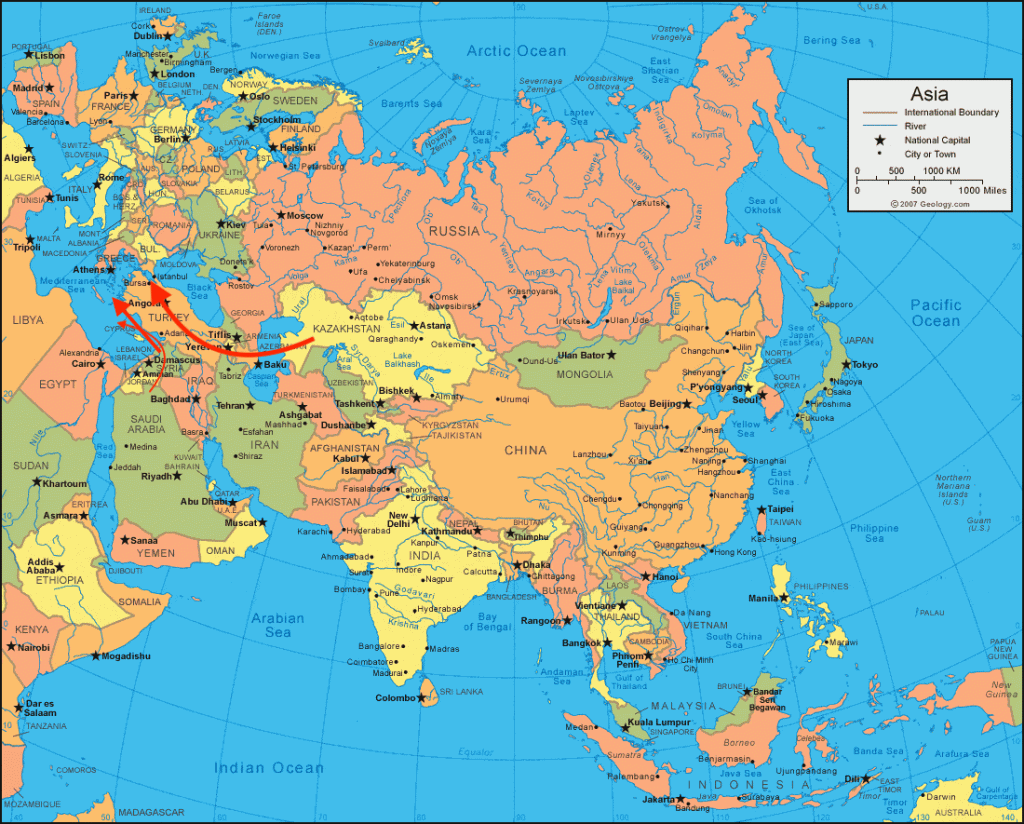
This is obviously to the benefit of Turkey which now sees Syria as part of its widening sphere of influence. Turkey wants to do two things as part of its grand vision of empire: It wants to revive the Ottoman Empire, which once controlled the entirety of the Middle East; and secondly it wants to do more than revive the old empire: it desires to create a neo-Ottoman empire, controlling also Central Asia. It was from Central Asia where the Seljuk Turks travelled into the Near East where their later successors, the Ottomans, would establish their empire. Hence why today’s Turkish nationalists see Central Asia as their ancestral homeland, and thus as a rightful part of the pan-Turkic realm of power. There is a competition between Turkey and Russia over who is going to influence the Central Asian Turkic countries, and since Turkey’s victory over Armenia in 2023 in Nagorno-Karabakh, pro-Turkish sentiment in Central Asia has been increasing tremendously. If Turkey can take over the Central Asian Turkic states, or at least deepen its ties with them, it will eventually become a global power, since it would become the main transit route for the exportation of oil and gas from Central Asia into the rest of Europe. Thus, Syria becoming a trade rout for oil is a win for Turkey and another boost in the looming Turkish power. On the other hand, Israel wants to become the major corridor through which the energy would be transported into Europe. Israel has been using the Hormuz Strait crisis to push this idea of Israel being an alternative to the Strait. Netanyahu, in March of 2026, affirmed that what is needed to bypass the Hormuz and Bab al-Mandeb Straits are “oil pipelines, gas pipelines going west through the Arabian Peninsula right up to Israel, right up to our Mediterranean ports, and you’ve just done away with the chokepoints for forever.” So Turkey is presenting itself and Syria as pipelines for moving oil and gas to Europe, and Israel — while having troops in Syria and being desirous of the Turks leaving that country — wants for itself to be an access-way into the Mediterranean for the transport of oil and gas to Europe. Being a major transport rout for Europe’s and Asia’s oil means transit fees, which means big money, influence and leverage. Eventually the Turks and the Israelis will war over Syria, and ultimately over who is going to reign over the Middle East.